Signs and markings · about 5 min read
Turn and U-turn prohibitions
Signs that remove a turning movement, now or at the next junction
What you will learn
- Tell a prohibition at the junction from one ahead.
- Identify which movements remain legal.
- Plan an alternative route without a last-second manoeuvre.
Turn and U-turn prohibitions: how to read them
These red-bordered signs remove one movement. The rest of the junction stays available. A left-turn prohibition means you may go straight on or turn right if that is permitted and safe.
Timing matters. R209 and R210 look ahead to the next intersection so that you can plan. R211 and R212 apply at the junction you are standing at. R213 forbids turning round to face the opposite direction, before or on the far side of an intersection.
Turn prohibitions often exist because a junction is too tight, too busy or has poor visibility for that movement. Treat them as information about the junction, not an obstacle to work around. If you miss the turn you wanted, a short detour is far safer than a forbidden manoeuvre.
Key idea: A crossed arrow removes that one movement. Plan an alternative early.
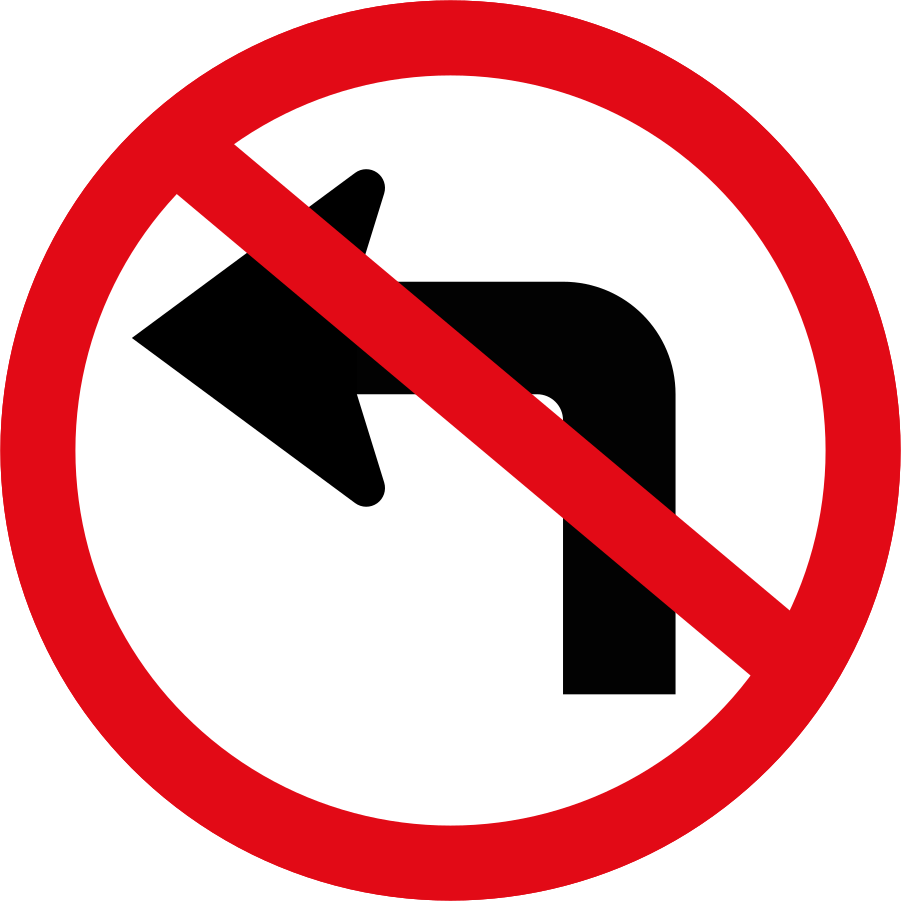
No left turn ahead — R209
A left turn is prohibited at the junction ahead.
Recognise it. A white disc with a red border showing a left-turn arrow crossed out. This version applies ahead of the junction.
Where you meet it. On a public road before an intersection, so you can plan another route.
What to do. Do not turn left at the intersection ahead. Go straight or choose another permitted direction.
In practice. A sign tells you the next junction forbids left turns. You get into the right lane early and plan a different route to your destination.
Easily confused. R209/R210 look ahead; R211/R212 apply at the junction itself.
Key idea: Choose another permitted direction at the junction.
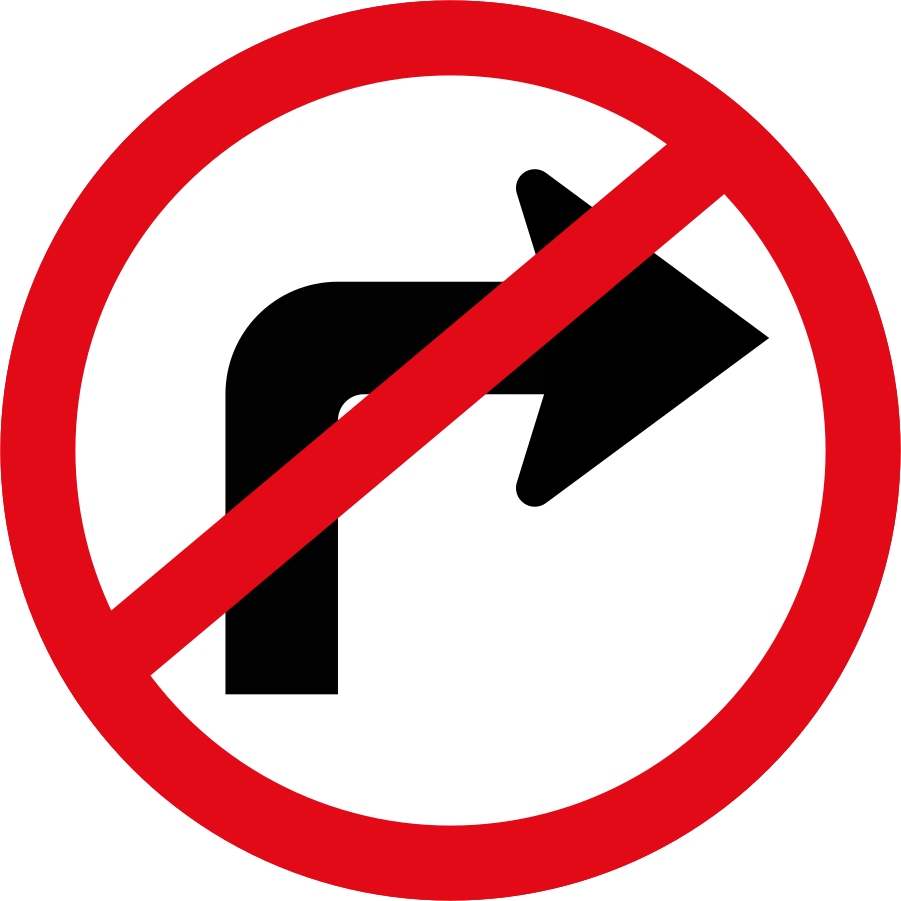
No right turn ahead — R210
A right turn is prohibited at the junction ahead.
Recognise it. A red-bordered disc with a right-turn arrow crossed out, applying to the junction ahead.
Where you meet it. On a public road before a junction where right turns are forbidden.
What to do. Do not turn right at the next intersection. Plan a route that avoids it.
In practice. You see the right-turn-ahead ban. You continue straight, turn right at a later junction and avoid braking sharply at the banned turn.
Easily confused. Check which junction the sign refers to. A sign before one junction does not forbid turns at later ones.
Key idea: Plan a route that does not use the prohibited turn.
No left turn — R211
Turning left at this point is prohibited.
Recognise it. A red-bordered disc with a left-turn arrow crossed out, applying at the junction where you are.
Where you meet it. At the intersection itself.
What to do. Do not turn left here. You may go straight on or turn right if that is permitted and safe.
Why it exists. A turn may be forbidden because the junction is tight, busy or has poor visibility for that movement. The sign removes the risky choice.
In practice. At the junction the left turn is forbidden. You go straight on instead and check for pedestrians as you pass the corner.
Easily confused. Prohibited left does not mean prohibited everything: the remaining movements are still available.
Key idea: Continue in a permitted direction rather than turning left.
No right turn — R212
Turning right at this point is prohibited.
Recognise it. A red-bordered disc with a right-turn arrow crossed out, applying at the junction where you are.
Where you meet it. At the intersection itself.
What to do. Do not turn right here. You may go straight on or turn left if allowed and safe.
Why it exists. A right turn may be forbidden for the same reasons as a left turn: tight geometry, heavy traffic or poor sight lines.
In practice. At the junction a right turn is forbidden. You turn left or carry on straight, then loop back by a legal route.
Easily confused. Do not make a last-second illegal turn from the wrong lane; take a permitted movement and reroute.
Key idea: Continue in a permitted direction rather than turning right.
No U-turn — R213
You may not turn around to face the opposite direction here.
Recognise it. A red-bordered disc with a U-shaped arrow crossed out.
Where you meet it. On a public road, either before or on the far side of an intersection.
What to do. Do not turn your vehicle round to face the opposite direction here. Carry on to a place where turning round is allowed and safe.
In practice. You miss your turning and see the no U-turn sign. You continue to the next junction where turning round is allowed and signal your move.
Easily confused. A series of left turns that brings you back is a different manoeuvre; this sign forbids the U-turn itself.
Key idea: Continue to a place where turning around is permitted and safe.
Now or ahead
Ahead signs give you time to move into the right lane and reroute. At-junction signs leave no room for a late change. In both cases, resist the temptation to make the forbidden turn from the wrong lane because it looks quiet.
A U-turn is its own movement. Several left turns that bring you back the other way are not what R213 forbids, but check the local layout carefully.
Key idea: A crossed arrow removes that one movement. Plan an alternative early.
A prohibited right turn
You see R212 at the junction you wanted to turn right at.
- Do not turn right, even though the road is empty.
- Continue straight on or turn left if permitted.
- Find a legal place to turn round and return.
- Check mirrors and signal for any change of lane.
Quick recap
- Ahead signs warn of the next junction.
- At-junction signs apply here.
- Other movements remain allowed.
- No U-turn means no turning round to face the opposite way.
Practice questions on turn and u-turn prohibitions
1 What does this sign mean?
- Vehicles may not enter from this direction.
- A left turn is prohibited at the junction ahead.
- The road curves ahead in the direction shown.
Show the answer
Answer B: A left turn is prohibited at the junction ahead.
Choose another permitted direction at the junction.
Memory tip: R209 · No left turn ahead
All vehicle codes
2 Which response fits this sign?
- Find a permitted route. This sign applies even when the road appears empty.
- Choose another permitted direction at the junction.
- Adjust speed before the curve.
Show the answer
Answer B: Choose another permitted direction at the junction.
No left turn ahead: A left turn is prohibited at the junction ahead.
Memory tip: Choose another permitted direction at the junction.
All vehicle codes
3 Which sign group does this example belong to?
- Warning
- Command
- Prohibition
Show the answer
Answer C: Prohibition
No left turn ahead is a prohibition sign. A left turn is prohibited at the junction ahead.
Memory tip: Choose another permitted direction at the junction.
All vehicle codes
4 What does this sign mean?
- A sharp bend lies ahead in the direction shown.
- Traffic travels in the direction shown by the arrow.
- A right turn is prohibited at the junction ahead.
Show the answer
Answer C: A right turn is prohibited at the junction ahead.
Plan a route that does not use the prohibited turn.
Memory tip: R210 · No right turn ahead
All vehicle codes
More signs and markings chapters
- Direction commands and roundabouts
- Who may use the road
- Speed signs
- Overtaking, parking and stopping bans
- Vehicle size and mass limits
- Pedestrian, cycle, noise and lift bans
Sources: NaTIS Road Traffic Signs, June 2012, PDF p. 13 (names, locations, purposes and actions); iDriving K53 manual, PDF pp. 6–42 (visual comparison; text extraction incomplete); SADC artwork: assets/signs/manifest.json (per-file sources and licences).
AceK53 is an independent study aid based on public road traffic manuals and is not an official test. Always confirm requirements with your driving licence testing centre.