Signs and markings · about 7 min read
Who may use the road
Routes for pedestrians, cyclists, motorcycles, cars, heavy vehicles and tolls
What you will learn
- Recognise routes reserved for particular road users.
- Apply the heavy-vehicle mass command correctly.
- Respond to toll and headlight commands.
Who may use the road: how to read them
Some blue commands set a road, or part of a road, aside for particular users. If the sign names your type of road user, you may use it. If it does not, stay out. Others tell you to do something: pay a toll, switch on headlights, or use a particular route if your vehicle is heavy enough.
The important habit is to ask whether the sign is about you. A cyclists-only sign does not apply to a cyclist, but it applies to every motor vehicle. A mass command applies only to heavier vehicles.
Key idea: A blue sign tells the named users where they belong. Everyone else stays out.
Pedestrians only — R110
This route is for pedestrians.
Recognise it. A blue circle with a white pedestrian symbol.
Where you meet it. At the start of a road or part of a road set aside for people on foot.
What to do. Do not drive into it. Pedestrians may use only the part indicated.
In practice. A pedestrian street opens on your left with this sign. You keep your car out, take the carriageway meant for vehicles and expect people to cross at the corner.
Easily confused. It is the opposite of R218, which keeps pedestrians out. Here the space belongs to them.
Key idea: Do not enter with a motor vehicle.
Cyclists only — R111
This route is for pedal cycles.
Recognise it. A blue circle with a white bicycle symbol.
Where you meet it. At the start of a road or part of a road for cyclists.
What to do. Keep motor vehicles out of the cycle route. Cyclists may use only the part marked.
Why it exists. Separating cyclists from motor traffic reduces the chance of serious collisions. The sign tells drivers to keep out of the route.
In practice. A cycle route joins the road ahead. You stay on the carriageway, leave the cycle route to cyclists and check for riders before turning across it.
Easily confused. Not the same as a painted bicycle lane beside a normal road. This sign reserves the whole route.
Key idea: Keep motor vehicles out of the cycle route.
Shared pedestrian and cycle route — R112
This route is for pedestrians and cyclists, not motor vehicles.
Recognise it. A blue circle showing both a pedestrian and a bicycle on one route.
Where you meet it. At the start of a path or road part shared by people on foot and on bicycles.
What to do. Do not drive on it. Pedestrians and cyclists share the space and must look out for one another.
In practice. A shared path runs beside the road. You never drive onto it. You look both ways before you cross it at a driveway, because cyclists and walkers may be using the whole width.
Easily confused. R112 shares one path. R113–R115 show versions where the route is split, so look for which symbol sits on which side.
Key idea: Do not enter with a motor vehicle. Cyclists and pedestrians use the shown shared route carefully.
Motorcycles only — R116
Only motorcycles may use this route.
Recognise it. A blue circle with a white motorcycle symbol.
Where you meet it. At the beginning of a road or part of a road that is reserved for motorcycles.
What to do. Only riders may use it. Drivers of other vehicles must take another route.
Why it exists. Reserving a road for motorcycles separates riders from larger vehicles in places where that is safer or more efficient.
In practice. A short road is reserved for motorcycles. You are in a car, so you choose the next street and leave it for riders.
Easily confused. The reverse of the “motorcycles prohibited” sign (R222), which excludes riders instead.
Key idea: Use another route if you are driving a different vehicle.
Motorcars only — R117
This route is restricted to motorcars.
Recognise it. A blue circle with a white car symbol.
Where you meet it. At the beginning of a road or part of a road reserved for motorcars.
What to do. If you are driving a motorcar, use that part of the road. Other vehicle types need their own matching sign before they may use it.
In practice. A road is reserved for motorcars. You drive a motorcar, so you may use it. A minibus beside you does not match the sign and takes another route.
Easily confused. A sign naming your vehicle type permits you; it does not permit every vehicle.
Key idea: Check that your vehicle is in the permitted class.
Vehicles over indicated mass only — R102
The indicated route is for vehicles exceeding the displayed GVM or GCM.
Recognise it. A blue circle with a mass figure in tonnes (the sample artwork shows 10 t).
Where you meet it. On any public road where heavier vehicles are directed onto the indicated part of the road.
What to do. If your vehicle’s GVM or GCM exceeds the tonnes shown, use the part of the road this sign marks. Lighter vehicles use the part that is not marked.
In practice. Your goods vehicle’s GVM is above the tonnes shown. You use the part of the road this sign marks, while a light delivery van follows the other part.
Easily confused. GVM and GCM are the maximum mass the manufacturer specifies, not just today’s load. The red-bordered mass limit (R202) works the other way round.
Key idea: Compare the vehicle or combination’s specified gross mass with the shown figure; use the designated route only if the command applies.
Toll road — R132
A toll payment is required on this road.
Recognise it. A blue command sign for a toll route.
Where you meet it. Before a toll plaza, giving a last chance to take another way.
What to do. Decide early whether you will pay or take the alternative, and get into the correct lane in good time.
In practice. A toll sign appears 1 km before the plaza with an alternative shown. You decide early, move into the correct lane and have your payment ready instead of changing lanes at the last moment.
Easily confused. It is not a warning of a collection point alone: it commands you to pay on that route.
Key idea: Use the appropriate toll lane and obey its signals.
Switch headlights on — R133
Headlights must be switched on.
Recognise it. A blue circle with a headlamp symbol.
Where you meet it. On any road, especially before tunnels and in mountain areas.
What to do. Switch on dipped headlights so you can see and be seen.
Why it exists. Seeing and being seen matter most where the light changes quickly, such as tunnels and mountain roads. The command makes sure your lights are on.
In practice. Ahead is a mountain tunnel with this sign. You switch on dipped headlights before entering, so you can see and be seen as the light changes.
Easily confused. It is not permission to use main beam. When the matching “end” sign (R133-600) appears, this particular command ends, but your other lighting duties do not.
Key idea: Use dipped headlights and avoid dazzling other drivers.
Allowing and excluding
R110, R111 and R112 set routes aside for pedestrians, cyclists, or both. R116 and R117 reserve a road for motorcycles or cars. R102 directs vehicles over a stated mass onto a particular route. R132 gives you a last chance to take an alternative before a toll. R133 requires dipped headlights.
These are the reverse of red-bordered prohibitions, which exclude a class instead. The blue ones say who belongs.
Key idea: A blue sign tells the named users where they belong. Everyone else stays out.
A shared path ahead of your turn
You see a blue sign with a pedestrian and a bicycle on a path that runs beside your turn.
- Recognise it as a route for people on foot and cyclists only.
- Keep your vehicle off the path.
- Watch for people crossing at the junction.
- Turn only into the carriageway meant for motor vehicles.
Quick recap
- A blue sign names who may use the route.
- GVM and GCM are specified maximums, not today’s load.
- R133 means dipped headlights, not main beam.
- Take the toll decision before the lane choice.
Practice questions on who may use the road
1 What does this sign mean?
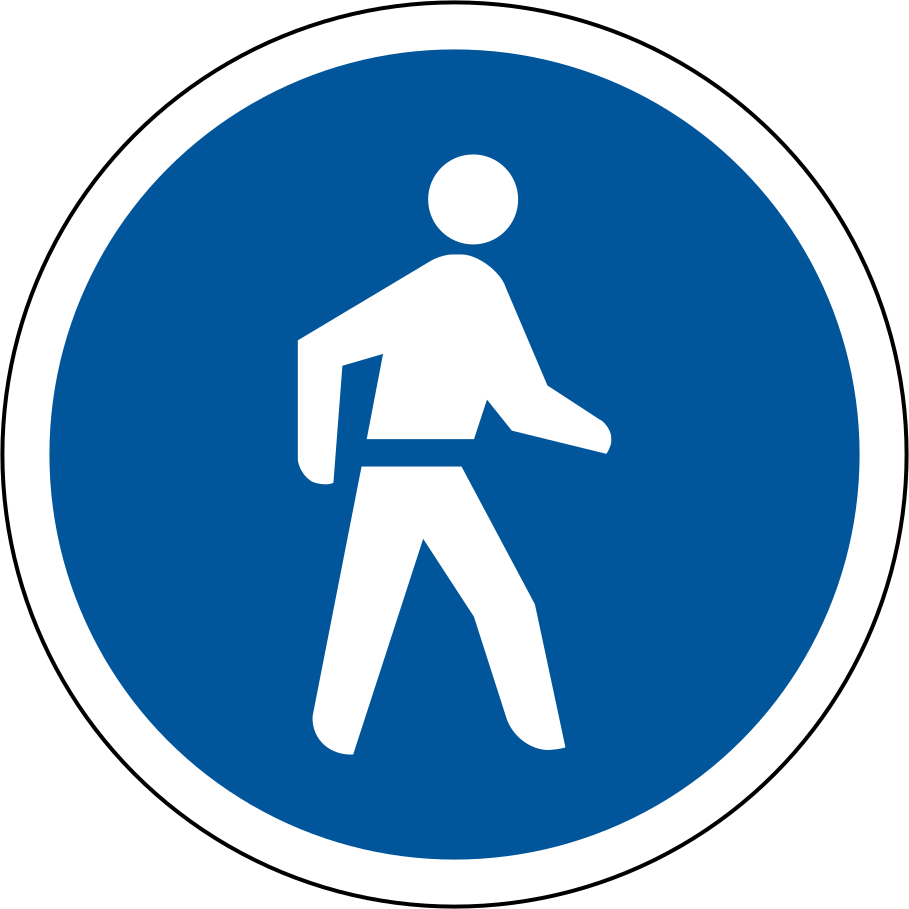
- This route is for pedestrians.
- The road changes direction ahead.
- You may not exceed 100 km/h.
Show the answer
Answer A: This route is for pedestrians.
Do not enter with a motor vehicle.
Memory tip: R110 · Pedestrians only
All vehicle codes
2 Which response fits this sign?
- A lower vehicle-specific speed limit still applies to your vehicle.
- Do not enter with a motor vehicle.
- Reduce speed before the bend, following the direction shown.
Show the answer
Answer B: Do not enter with a motor vehicle.
Pedestrians only: This route is for pedestrians.
Memory tip: Do not enter with a motor vehicle.
All vehicle codes
3 Which sign group does this example belong to?
- Warning
- Prohibition
- Command
Show the answer
Answer C: Command
Pedestrians only is a command sign. This route is for pedestrians.
Memory tip: Do not enter with a motor vehicle.
All vehicle codes
4 What does this sign mean?
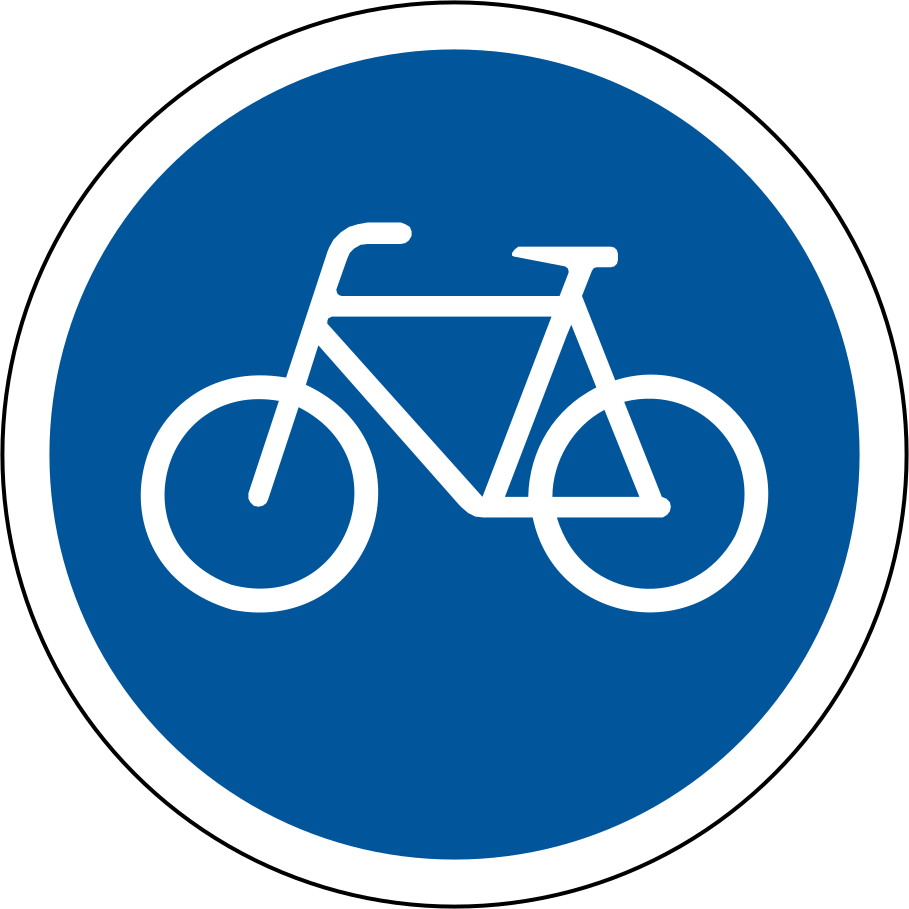
- This route is for pedal cycles.
- You may not exceed 120 km/h.
- Oncoming traffic uses the road ahead.
Show the answer
Answer A: This route is for pedal cycles.
Keep motor vehicles out of the cycle route.
Memory tip: R111 · Cyclists only
All vehicle codes
More signs and markings chapters
- Yield and priority signs
- No entry and one-way roads
- Direction commands and roundabouts
- Speed signs
- Turn and U-turn prohibitions
- Overtaking, parking and stopping bans
Sources: NaTIS Road Traffic Signs, June 2012, PDF pp. 7–10 (names, locations, purposes and actions); iDriving K53 manual, PDF pp. 6–42 (visual comparison; text extraction incomplete); SADC artwork: assets/signs/manifest.json (per-file sources and licences).
AceK53 is an independent study aid based on public road traffic manuals and is not an official test. Always confirm requirements with your driving licence testing centre.