Signs and markings · about 7 min read
Speed signs
Maximum limits, the minimum-speed sign and the general limits behind them
What you will learn
- Read red-bordered maximums and blue minimums correctly.
- Relate posted limits to general and vehicle-class limits.
- Adjust speed below the limit when conditions require it.
Speed signs: how to read them
A red-bordered circle with a number is a maximum speed in km/h, applying from the sign onwards. A blue circle with a number is a minimum speed. The two look similar but ask for opposite things, so check the colour before the number.
General limits apply even without a sign: 60 km/h in urban areas, 100 km/h on other roads outside urban areas, and 120 km/h on freeways. Some vehicles have lower limits: 100 km/h for buses and minibuses, and 80 km/h for goods vehicles over 9,000 kg and some combinations. A higher posted limit never cancels a lower class limit.
Key idea: Red border: no more than. Blue: no less than. Conditions can require much less.
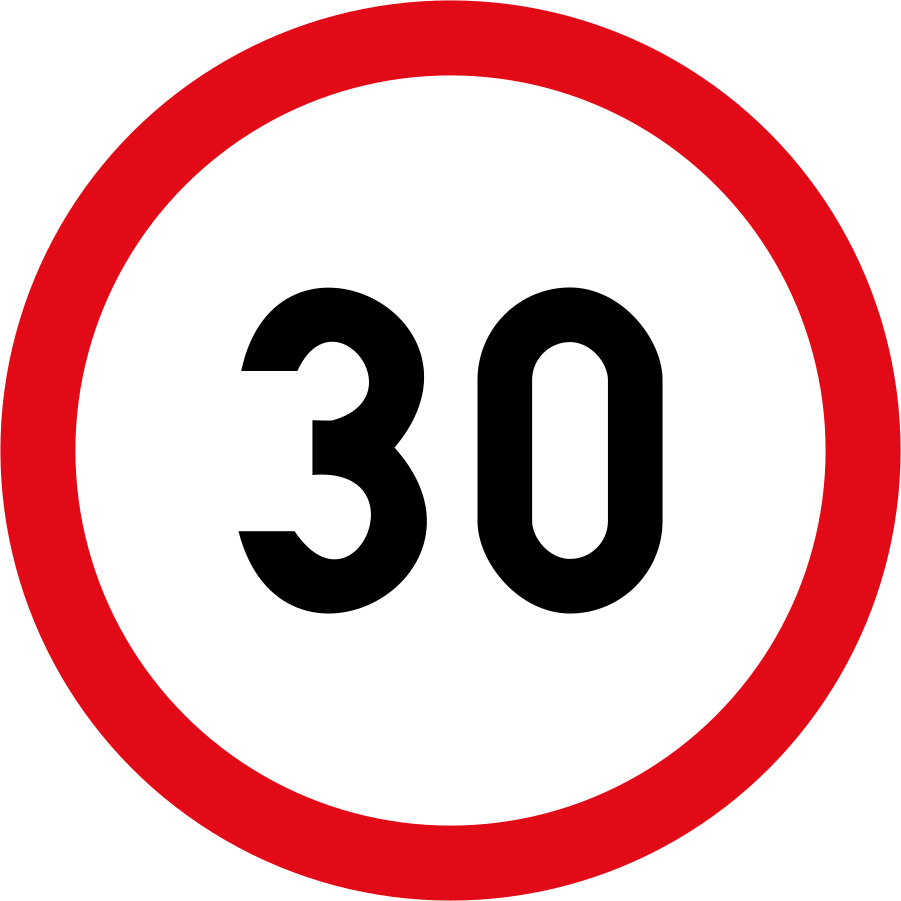
Maximum speed 30 — R201-30
You may not exceed 30 km/h.
Recognise it. A white disc with a red border and the number 30.
Where you meet it. Any public road, from the sign onwards. A limit this low tells you the road is expected to carry people, narrow spaces or other close hazards.
What to do. Keep to 30 km/h or less. Go slower whenever conditions need it.
In practice. A 30 sign appears near a school. You slow well before the sign, watch the pavement for children and keep your foot ready to brake.
Easily confused. The living-street area sign (R403) carries a 30 km/h rule too, but it adds pedestrian priority and other conditions that a plain limit sign does not.
Key idea: Stay at or below 30 km/h and drive more slowly if conditions require it.
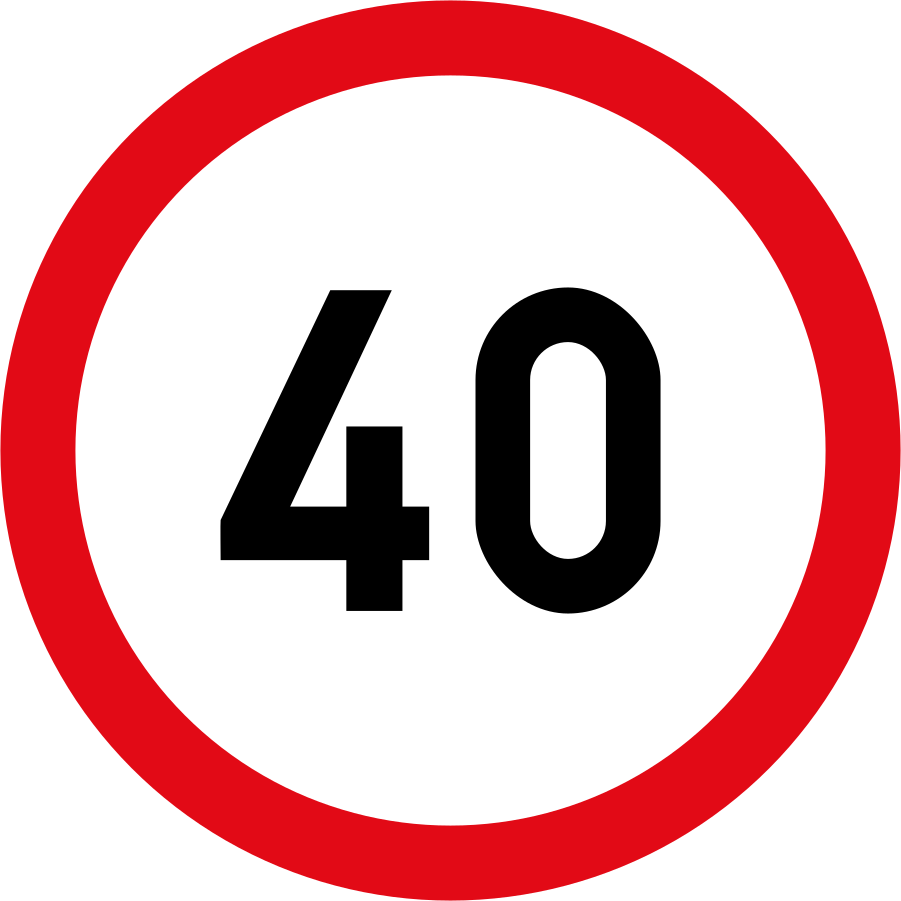
Maximum speed 40 — R201-40
You may not exceed 40 km/h.
Recognise it. A white disc with a red border and the number 40.
Where you meet it. Any public road, from the sign onwards, where a low limit protects pedestrians or other road users.
What to do. Do not exceed 40 km/h. Reduce further for traffic, weather or visibility.
In practice. A road narrowed by parked cars carries a 40 sign. You stay at or below 40, and you go slower when a pedestrian steps between the cars.
Easily confused. The number is the ceiling, not a target. Use the extra seconds to look for hazards.
Key idea: Stay at or below 40 km/h and drive more slowly if conditions require it.
Maximum speed 50 — R201-50
You may not exceed 50 km/h.
Recognise it. A white disc with a red border and the number 50.
Where you meet it. Any public road, from the sign onwards.
What to do. Keep at or below 50 km/h, and lower if conditions require it.
Why it exists. A limit gives every driver the same maximum, so that traffic and pedestrians can predict one another. The number is chosen for the road’s layout and use.
In practice. Passing roadworks with a 50 limit, you hold 50 or less. When it begins to rain, you slow further because the limit assumes good conditions.
Easily confused. Do not confuse it with the blue minimum-speed sign showing a similar number.
Key idea: Stay at or below 50 km/h and drive more slowly if conditions require it.
Maximum speed 60 — R201-60
You may not exceed 60 km/h.
Recognise it. A white disc with a red border and the number 60.
Where you meet it. Any public road. This number matches the general urban limit, so you may see it where the rule would apply anyway to remind drivers.
What to do. Stay at or below 60 km/h. Slow down if rain, traffic or pedestrians make 60 unsafe.
In practice. You enter a town with a 60 limit. You drop to 60 before the sign, because the limit applies from the sign, and check for side roads.
Easily confused. A posted limit never cancels a lower limit that applies to your vehicle class.
Key idea: Drive more slowly when weather, traffic or visibility requires it.
Maximum speed 80 — R201-80
You may not exceed 80 km/h.
Recognise it. A white disc with a red border and the number 80.
Where you meet it. Any public road. Goods vehicles over 9,000 kg and some combinations have an 80 km/h limit even where a higher one is posted.
What to do. Keep to 80 km/h at most. Leave a bigger gap in the wet.
In practice. A truck with a 10,000 kg GVM sees an 80 limit. It already has to stay at or below 80 km/h, so the sign confirms it. A car should still slow in rain.
Easily confused. A limit is the maximum in good conditions, not permission to travel at that speed in rain, mist or heavy traffic.
Key idea: The posted limit is a ceiling, not a target.
Maximum speed 100 — R201-100
You may not exceed 100 km/h.
Recognise it. A white disc with a red border and the number 100.
Where you meet it. Any public road. It matches the general limit outside urban areas, and the manual’s limit for buses and minibuses.
What to do. Do not exceed 100 km/h, and slow for bends, junctions and poor visibility.
In practice. On a rural road with a 100 limit, you keep below 100 on a bend, because the number is the highest speed allowed in good conditions.
Easily confused. If your vehicle class has a lower limit, that lower limit still applies.
Key idea: A lower vehicle-specific speed limit still applies to your vehicle.
Maximum speed 120 — R201-120
You may not exceed 120 km/h.
Recognise it. A white disc with a red border and the number 120.
Where you meet it. Mainly freeways, matching the freeway’s general maximum.
What to do. Do not exceed 120 km/h, and drive slower when conditions require it.
Why it exists. The freeway limit matches the highest speed allowed in good conditions. It cannot account for rain, fog or heavy traffic, so you must.
In practice. On a freeway marked 120 it is raining heavily. You slow well below 120 and keep a long gap, because the limit is not a target.
Easily confused. It is not a target. Goods vehicles and buses still follow their own lower limits.
Key idea: Adjust your speed to the road and weather conditions.
Minimum speed — R101
The number is a minimum speed, not a maximum.
Recognise it. A blue circle with a white number. It looks like a speed limit but is blue, not red-bordered.
Where you meet it. Roads where slow vehicles would otherwise disrupt the flow of traffic.
What to do. Do not drive slower than the number shown, in km/h, where conditions allow. Never speed up into danger to satisfy it.
In practice. A long uphill road has a minimum-speed sign. You keep to at least the number shown where the road is clear, but you do not speed up if a hazard appears.
Easily confused. Blue means “at least”, red-bordered means “no more than”. This sign is the one most often misread in tests.
Key idea: Maintain at least the indicated speed where conditions are safe. Never increase speed into danger.
Maximum, minimum and conditions
R201 signs are maximums. The lower the number, the closer the road expects people or hazards to be near your vehicle. R101 is the minimum, used where slow vehicles would disrupt flow.
A limit is the highest speed allowed in good conditions, not a target. Rain, fog, traffic, a wet surface or a heavy load can make a lower speed the only safe one.
Key idea: Red border: no more than. Blue: no less than. Conditions can require much less.
A goods vehicle on a freeway
A goods vehicle with a GVM of 10,000 kg passes a 120 sign on a wet freeway.
- Recall that goods vehicles over 9,000 kg have an 80 km/h limit.
- Keep to 80 km/h at most, not 120.
- Increase the following gap because of the wet road.
- Reduce further if visibility is poor.
Quick recap
- Red-bordered number: maximum.
- Blue number: minimum.
- Lower vehicle-class limits still apply.
- Slow down for conditions.
Practice questions on speed signs
1 What does this sign mean?
- You may not exceed 30 km/h.
- Hitch-hiking is prohibited on this road section.
- Stop for straight or right movements; left-turning traffic must yield.
Show the answer
Answer A: You may not exceed 30 km/h.
Stay at or below 30 km/h and drive more slowly if conditions require it.
Memory tip: R201-30 · Maximum speed 30
All vehicle codes
2 Which response fits this sign?
- For a left turn, yield to relevant traffic and pedestrians and proceed only when safe. For other movements, stop behind the line.
- Stay at or below 30 km/h and drive more slowly if conditions require it.
- Do not seek a lift by hitch-hiking here.
Show the answer
Answer B: Stay at or below 30 km/h and drive more slowly if conditions require it.
Maximum speed 30: You may not exceed 30 km/h.
Memory tip: Stay at or below 30 km/h and drive more slowly if conditions require it.
All vehicle codes
3 Which sign group does this example belong to?
- Command
- Warning
- Prohibition
Show the answer
Answer C: Prohibition
Maximum speed 30 is a prohibition sign. You may not exceed 30 km/h.
Memory tip: Stay at or below 30 km/h and drive more slowly if conditions require it.
All vehicle codes
4 What does this sign mean?
- You may not exceed 40 km/h.
- Only authorised vehicles may enter.
- The three junction approaches have stop controls.
Show the answer
Answer A: You may not exceed 40 km/h.
Stay at or below 40 km/h and drive more slowly if conditions require it.
Memory tip: R201-40 · Maximum speed 40
All vehicle codes
Part of the guide: Speed limits and following distance
More signs and markings chapters
- No entry and one-way roads
- Direction commands and roundabouts
- Who may use the road
- Turn and U-turn prohibitions
- Overtaking, parking and stopping bans
- Vehicle size and mass limits
Sources: NaTIS Road Traffic Signs, June 2012, PDF pp. 7, 11, 28 (names, locations, purposes and actions); iDriving K53 manual, PDF pp. 6–42 (visual comparison; text extraction incomplete); SADC artwork: assets/signs/manifest.json (per-file sources and licences).
AceK53 is an independent study aid based on public road traffic manuals and is not an official test. Always confirm requirements with your driving licence testing centre.