Signs and markings · about 5 min read
Overtaking, parking and stopping bans
Signs that restrict passing and leaving your vehicle
What you will learn
- Apply the 500 m overtaking ban and its heavy-vehicle version.
- Distinguish no parking from no stopping.
- Know the permitted exceptions to a stopping ban.
Overtaking, parking and stopping bans: how to read them
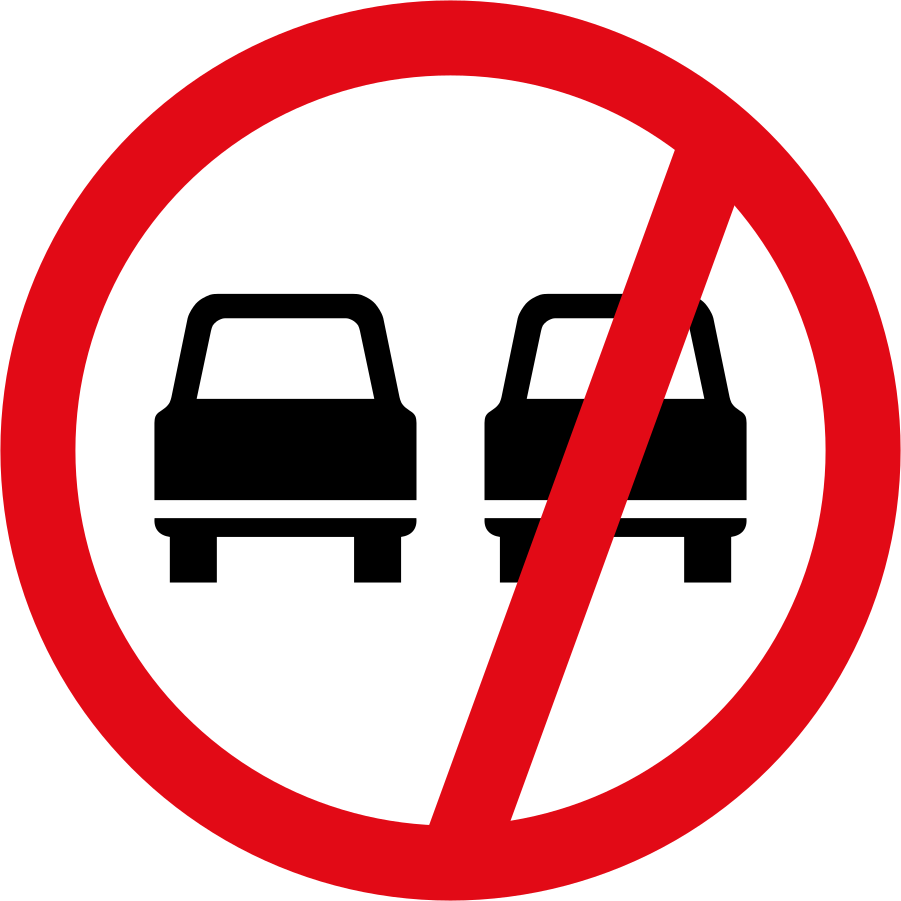
Four red-bordered signs control where you may pass and where you may leave your vehicle. R214 bans overtaking for the next 500 metres. R215 bans heavy vehicles from overtaking other heavy vehicles.
Parking and stopping are different. Parking means a vehicle is stationary longer than is reasonably necessary to load or unload. Stopping means bringing a vehicle to a standstill for any reason you choose. A no-parking sign bans the first; a no-stopping sign bans the second.
The overtaking ban measures distance from the sign, so it keeps applying even when the road ahead looks clear. If a no-stopping sign is supported by a red line along the kerb, the line extends the restriction to the whole stretch it covers.
Key idea: One bar bans parking. A cross bans stopping altogether.
No overtaking — R214
Overtaking other motor vehicles is prohibited for the next 500 metres.
Recognise it. A white disc with a red border showing two cars side by side, one red.
Where you meet it. On any public road. It warns that overtaking is prohibited for the next 500 metres.
What to do. Do not overtake any vehicle in that distance. Stay at a safe following distance and be patient.
In practice. Behind a slow lorry you see the overtaking ban. You stay behind it for the next 500 metres, even though the road ahead looks clear.
Easily confused. The heavy-vehicle version (R215) is narrower in scope. Do not mix up the two.
Key idea: Stay behind the vehicle ahead and obey the road markings.
No heavy-vehicle overtaking — R215
Heavy vehicles may not overtake other heavy vehicles for the next 500 metres.
Recognise it. A white disc with a red border showing a heavy vehicle overtaking another, one crossed in red.
Where you meet it. On any public road where heavy vehicles must not pass each other.
What to do. If you are driving a heavy vehicle, stay behind the heavy vehicle ahead. Other vehicles are not covered by this sign.
In practice. You drive a loaded truck and see the heavy-vehicle sign. You stay behind the truck ahead. A car behind you may still pass if no other sign forbids it.
Easily confused. Cars may still overtake unless another sign or marking forbids it.
Key idea: If the restriction applies to your vehicle, remain behind the heavy vehicle ahead.
No parking — R216
You may not park on this section of road.
Recognise it. A red-bordered disc with a blue centre and a single red diagonal bar across it.
Where you meet it. Roads that are narrow, near an intersection, or where a parked vehicle would block other drivers’ view.
What to do. Do not park here at any time of day or night. A short stop for a real reason is different from parking.
In practice. A narrow road near an intersection has a no-parking sign. You drive on and park where it is allowed, instead of leaving the car for a few minutes.
Easily confused. No parking is not no stopping. The sign that bans all voluntary stops uses a red cross (R217).
Key idea: Find a permitted parking place. No parking and no stopping are different restrictions.
No stopping — R217
Voluntary stopping is prohibited here.
Recognise it. A red-bordered disc with a blue centre crossed by a red X.
Where you meet it. Any public road. Often supported by a red no-stopping line along the kerb.
What to do. Do not stop at all, except to obey a signal or traffic officer, or to avoid a collision. That includes dropping off and picking up people.
In practice. A friend asks you to stop for a second at a no-stopping sign. You explain that you cannot stop there and drop them at the next safe place.
Easily confused. It is stricter than no parking. A broken red line may only apply during the times on a nearby sign.
Key idea: Do not stop to collect or drop off passengers. Obey traffic controls and emergencies.
Parking versus stopping
The no-parking sign has one red diagonal bar. The no-stopping sign has a red cross. Under no parking you may still stop briefly for a real reason, such as dropping off. Under no stopping you may not stop to let someone out. The exceptions are a traffic light or officer, and avoiding a collision.
A broken red line can mean the ban applies only at times shown on a nearby sign.
Key idea: One bar bans parking. A cross bans stopping altogether.
Dropping off at a no-stopping sign
A passenger asks you to stop briefly where R217 stands.
- Recognise the red cross as no stopping.
- Do not stop, even for a few seconds.
- Drive to the nearest legal place.
- Check mirrors before leaving your lane.
Quick recap
- R214: no overtaking for 500 m.
- R215: heavy vehicles do not pass heavy vehicles.
- R216: no parking.
- R217: no stopping except for lights, officers or collision avoidance.
Practice questions on overtaking, parking and stopping bans
1 What does this sign mean?
- Cattle may cross or be on the road ahead.
- Your road ends at a T-junction ahead.
- Overtaking other motor vehicles is prohibited for the next 500 metres.
Show the answer
Answer C: Overtaking other motor vehicles is prohibited for the next 500 metres.
Stay behind the vehicle ahead and obey the road markings.
Memory tip: R214 · No overtaking
All vehicle codes
2 Which response fits this sign?
- Reduce speed and be ready to stop for animals.
- Stay behind the vehicle ahead and obey the road markings.
- Reduce speed and prepare to turn left or right.
Show the answer
Answer B: Stay behind the vehicle ahead and obey the road markings.
No overtaking: Overtaking other motor vehicles is prohibited for the next 500 metres.
Memory tip: Stay behind the vehicle ahead and obey the road markings.
All vehicle codes
3 Which sign group does this example belong to?
- Warning
- Prohibition
- Command
Show the answer
Answer B: Prohibition
No overtaking is a prohibition sign. Overtaking other motor vehicles is prohibited for the next 500 metres.
Memory tip: Stay behind the vehicle ahead and obey the road markings.
All vehicle codes
4 What does this sign mean?
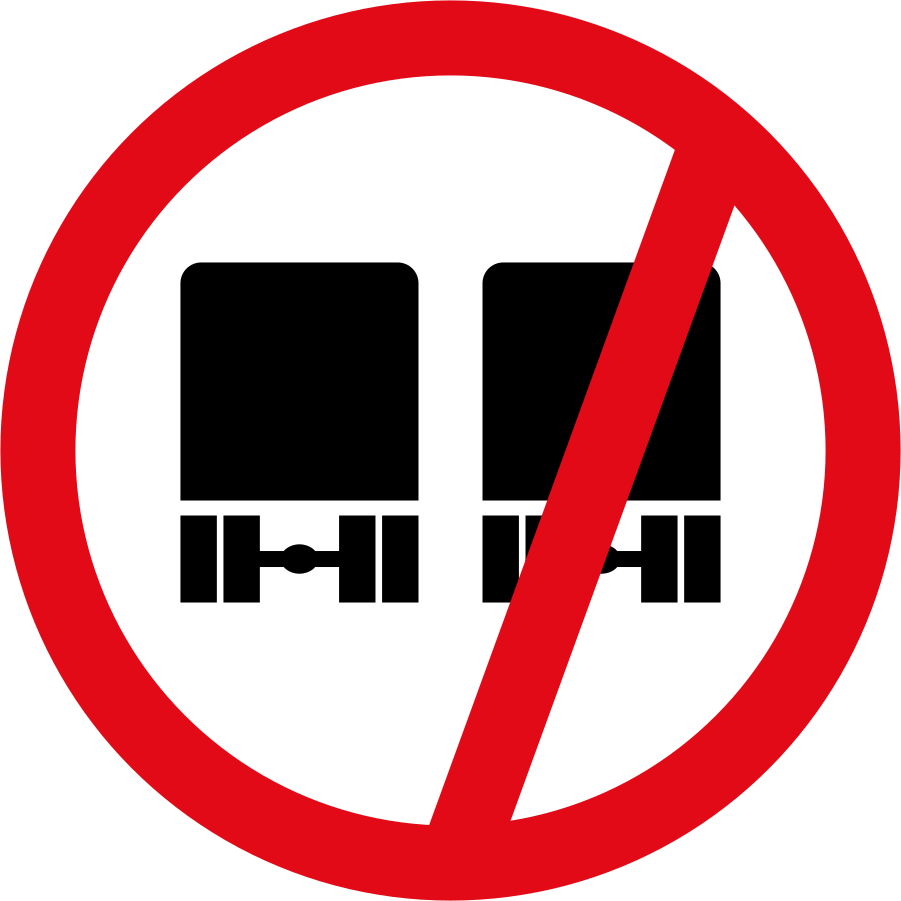
- Heavy vehicles may not overtake other heavy vehicles for the next 500 metres.
- Horses may be on or near the road ahead.
- The road changes direction ahead.
Show the answer
Answer A: Heavy vehicles may not overtake other heavy vehicles for the next 500 metres.
If the restriction applies to your vehicle, remain behind the heavy vehicle ahead.
Memory tip: R215 · No heavy-vehicle overtaking
All vehicle codes
Part of the guide: Overtaking
More signs and markings chapters
- Who may use the road
- Speed signs
- Turn and U-turn prohibitions
- Vehicle size and mass limits
- Pedestrian, cycle, noise and lift bans
- Reserved lanes and freeways
Sources: NaTIS Road Traffic Signs, June 2012, PDF p. 13 (names, locations, purposes and actions); iDriving K53 manual, PDF pp. 6–42 (visual comparison; text extraction incomplete); SADC artwork: assets/signs/manifest.json (per-file sources and licences).
AceK53 is an independent study aid based on public road traffic manuals and is not an official test. Always confirm requirements with your driving licence testing centre.