Signs and markings · about 7 min read
Vehicle size and mass limits
Mass, axle, height and length signs, and the warnings that precede them
What you will learn
- Compare your vehicle’s measurements to the signed limit.
- Use the warning signs to reroute in time.
- Recognise a road closed to unauthorised vehicles.
Vehicle size and mass limits: how to read them
These signs protect structures and narrow roads. Each states a limit and you must compare it to your own vehicle, including the load. Measure from the ground to the highest point for height, include the whole combination for length, and use the manufacturer’s maximum for mass.
The warnings (W320 and W321) come first and give you time to turn off. The red-bordered signs (R202 to R205) are the rules themselves. R208 closes a road to everyone without special permission, often at roadworks.
A restriction sign cannot know what you are carrying. Before a trip with a tall load, a trailer or an unusual cargo, work out your vehicle’s height, width, length and mass, and write the numbers where you can see them. Checking once at the start is easier than discovering a limit at the bridge.
Key idea: Measure your whole vehicle and load before the sign, not at it.
Gross mass restriction — R202
Vehicles exceeding the displayed gross mass may not proceed.
Recognise it. A red-bordered disc showing a mass figure in tonnes.
Where you meet it. On any public road, to keep overweight vehicles off roads or bridges they could damage.
What to do. If your vehicle’s GVM or GCM exceeds the figure, use another road. Vehicles below the limit may use the road.
In practice. Your delivery truck is heavier than the sign allows. You take another road, even though it is longer, to avoid damaging a weak bridge.
Easily confused. The command sign R102 pushes heavy vehicles onto a route; R202 keeps them off one.
Key idea: Check the permitted mass shown and the applicable mass of your vehicle.
Axle mass restriction — R203
An axle mass restriction applies as shown.
Recognise it. A red-bordered disc showing a figure for the mass on a single axle.
Where you meet it. On any public road where axle loads would damage the surface.
What to do. If any axle of your vehicle carries more than the figure in tonnes, take another route.
In practice. A bridge restricts axle mass. You weigh your load and find that one axle is overloaded, so you redistribute it before using the road.
Easily confused. Overall mass can be within limits and still overload one axle, so check how the load is distributed.
Key idea: Check the axle load before proceeding beyond the sign.
Height restriction — R204
Vehicles higher than the displayed limit may not proceed.
Recognise it. A red-bordered disc showing a height in metres with arrows above and below it.
Where you meet it. On any public road with a low structure such as a bridge.
What to do. If your vehicle or its load is taller than the height shown, use a different road. Measure from the ground to the highest point, including the load.
In practice. A low bridge shows 3.8 m. You measured your load at 4.1 m, so you take another route before you reach it.
Easily confused. The matching warning (W320) tells you the structure is ahead; this sign is the actual restriction.
Key idea: Check the height of the whole vehicle and load.
Length restriction — R205
Vehicles exceeding the displayed length may not proceed.
Recognise it. A red-bordered disc showing a length in metres between arrows.
Where you meet it. On any public road, especially in mountain areas, where sharp bends would trap long vehicles.
What to do. If your vehicle or combination is longer than the figure, find another route. Count the whole combination, not only the cab.
In practice. A winding mountain road restricts length. Your truck with a trailer is longer than the figure, so you use the highway instead.
Easily confused. Its warning counterpart is W321. The numeric sign is the rule; the warning only prepares you.
Key idea: Check the length of the whole vehicle combination.
Height restriction ahead — W320
A height restriction applies ahead.
Recognise it. A triangle with a height figure above a structure.
Where you meet it. Ahead of a structure with limited height.
What to do. If your vehicle or load is taller than the figure, find another route before you reach it.
Why it exists. Hitting a structure with a tall load can bring down the structure and injure people. The warning gives you a chance to avoid the problem.
In practice. A height warning appears before a low underpass. You check your tall load against the number and take a different route in time.
Easily confused. The red-bordered height sign (R204) is the rule; this triangle only prepares you.
Key idea: Check your vehicle and load height before proceeding.
Length restriction ahead — W321
A vehicle-length restriction applies ahead.
Recognise it. A triangle with a length figure beside a vehicle.
Where you meet it. Ahead of a stretch where bends or structures prevent long vehicles passing.
What to do. If your vehicle or combination is longer than the figure, find another route.
Why it exists. Sharp bends and structures can make a road impossible for long vehicles. The warning gives drivers time to turn off before they are trapped.
In practice. A length warning before a mountain pass. Your combination exceeds the figure, so you plan an alternative route before the turn-off, instead of discovering the problem at the first tight bend.
Easily confused. The length warning matches R205. The warning is not the restriction itself.
Key idea: Check that your vehicle combination meets the restriction.
Unauthorised vehicles prohibited — R208
Only authorised vehicles may enter.
Recognise it. A white disc with a red border and a vehicle symbol, closing the road to general traffic.
Where you meet it. Roads that must be closed to everyone except authorised vehicles, commonly at roadworks.
What to do. Do not enter unless you have special permission. Look for the detour signs and follow them.
In practice. A road is closed to unauthorised vehicles for repairs. You follow the signed detour even though it adds a few minutes, and you do not slip past the barrier when it looks quiet.
Easily confused. A temporary yellow version appears at roadworks. The yellow background means the closure is not permanent.
Key idea: Do not enter unless your vehicle has the required authorisation.
Warning versus rule
A triangle warns that a restriction is coming. The red-bordered circle is the restriction. If you wait until you read the rule you may have no place to turn.
Mass and axle limits are different: a vehicle can be within the overall mass limit yet overload one axle if the load sits badly.
Key idea: Measure your whole vehicle and load before the sign, not at it.
A high load and a low bridge
A height warning appears and your load is 4.1 metres tall.
- Read the figure on the warning sign.
- Compare it to your measured height including the load.
- If your load is higher, turn off to an alternative route.
- Do not rely on judging the clearance by eye.
Quick recap
- Triangle warns; red circle restricts.
- Height includes the load.
- Length includes the whole combination.
- R208 means do not enter without permission.
Practice questions on vehicle size and mass limits
1 What does this sign mean?
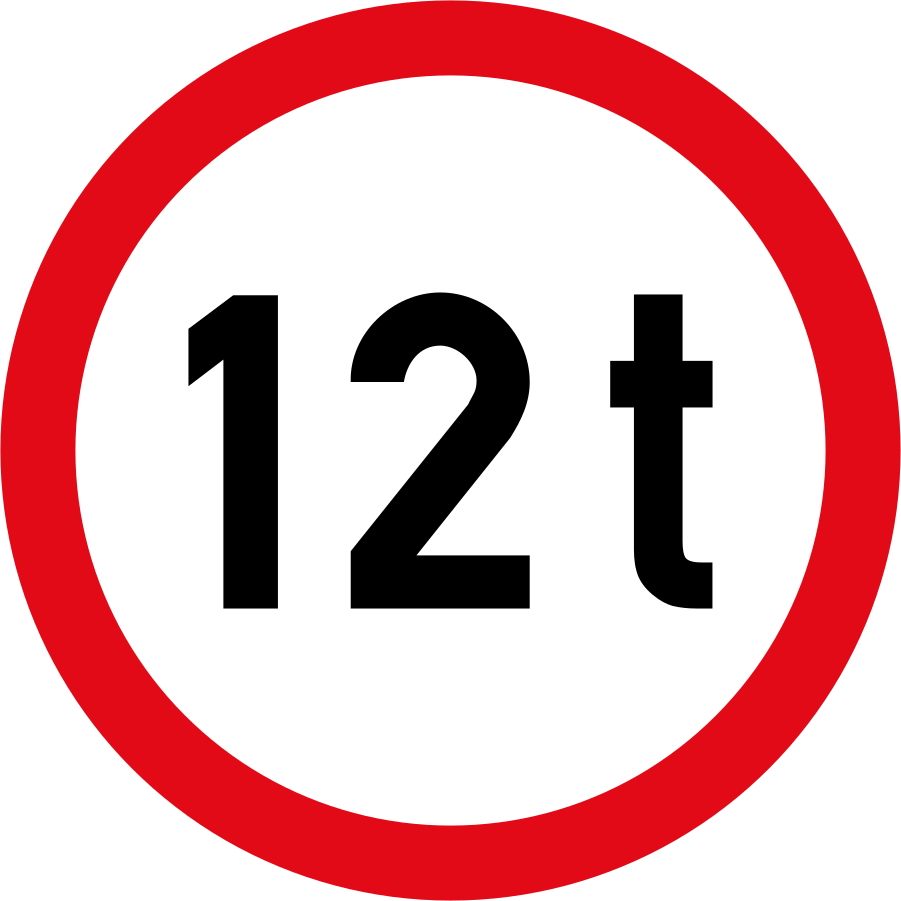
- The indicated route is for vehicles exceeding the displayed GVM or GCM.
- Vehicles exceeding the displayed gross mass may not proceed.
- Turning right at this point is prohibited.
Show the answer
Answer B: Vehicles exceeding the displayed gross mass may not proceed.
Check the permitted mass shown and the applicable mass of your vehicle.
Memory tip: R202 · Gross mass restriction
All vehicle codes
2 Which response fits this sign?
- Continue in a permitted direction rather than turning right.
- Check the permitted mass shown and the applicable mass of your vehicle.
- Compare the vehicle or combination’s specified gross mass with the shown figure; use the designated route only if the command applies.
Show the answer
Answer B: Check the permitted mass shown and the applicable mass of your vehicle.
Gross mass restriction: Vehicles exceeding the displayed gross mass may not proceed.
Memory tip: Check the permitted mass shown and the applicable mass of your vehicle.
All vehicle codes
3 Which sign group does this example belong to?
- Prohibition
- Command
- Warning
Show the answer
Answer A: Prohibition
Gross mass restriction is a prohibition sign. Vehicles exceeding the displayed gross mass may not proceed.
Memory tip: Check the permitted mass shown and the applicable mass of your vehicle.
All vehicle codes
4 What does this sign mean?
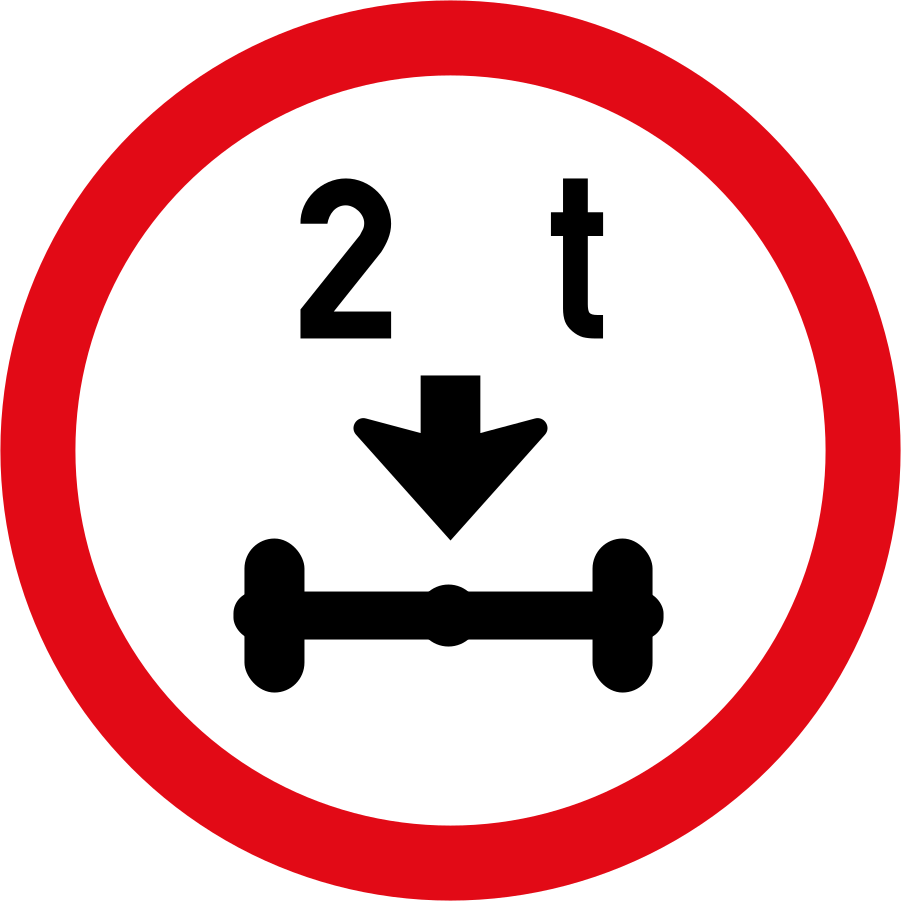
- An axle mass restriction applies as shown.
- This route is for pedestrians and cyclists, not motor vehicles.
- Your road ends at an angled T-junction ahead.
Show the answer
Answer A: An axle mass restriction applies as shown.
Check the axle load before proceeding beyond the sign.
Memory tip: R203 · Axle mass restriction
All vehicle codes
More signs and markings chapters
- Speed signs
- Turn and U-turn prohibitions
- Overtaking, parking and stopping bans
- Pedestrian, cycle, noise and lift bans
- Reserved lanes and freeways
- Junction warning signs
Sources: NaTIS Road Traffic Signs, June 2012, PDF pp. 12, 29–30 (names, locations, purposes and actions); iDriving K53 manual, PDF pp. 6–42 (visual comparison; text extraction incomplete); SADC artwork: assets/signs/manifest.json (per-file sources and licences).
AceK53 is an independent study aid based on public road traffic manuals and is not an official test. Always confirm requirements with your driving licence testing centre.