Signs and markings · about 7 min read
Junction warning signs
Crossroads, T-junctions, angled and staggered side roads
What you will learn
- Tell a crossroad, T-junction and side road apart.
- Read which side a road joins from.
- Prepare for junctions that hide vehicles.
Junction warning signs: how to read them
Junction warnings show the shape of what is ahead. The drawing is a small map: a cross for a crossroad, a T where your road ends, a branch where another road joins. Reading the shape tells you what traffic could appear and from where.
They do not tell you who has priority. They tell you to slow, look and be ready. Priority comes from the signs and markings at the junction itself.
Concealed driveways are a related hazard. The manual warns that drivers entering from a hidden driveway often find it as hard to see you as you do to see them. Slow down where a driveway or side road is concealed and be ready to stop.
Key idea: Read the shape: does my road continue or end, and from which side does traffic join?
Crossroad ahead — W101
A road crosses your route ahead.
Recognise it. A triangle with a plain cross showing a road crossing yours.
Where you meet it. On any road, before a crossroad.
What to do. Approach carefully, look both ways and be able to stop if cross-traffic requires it.
In practice. On a country road a crossroad warning appears. You ease off, check both sides and keep your speed low enough to stop if a vehicle appears from the side.
Easily confused. It warns that a junction is near. It does not say who has priority; the signs at the junction itself do.
Key idea: Look for vehicles entering from either side and observe junction controls.
T-junction ahead — W104
Your road ends at a T-junction ahead.
Recognise it. A triangle showing your road ending against a road that runs across it.
Where you meet it. Before the place where two roads meet at a T.
What to do. Slow down, watch for cross-traffic and be ready to stop and turn left or right at a safe speed.
In practice. A T-junction warning appears before your road ends. You slow down, check cross-traffic and choose left or right in good time, signalling before you brake so that traffic behind is not surprised.
Easily confused. Your road ends, so you must turn. It differs from a side road joining, where your road continues.
Key idea: Reduce speed and prepare to turn left or right.
Skewed T-junction — W105
Your road ends at an angled T-junction ahead.
Recognise it. A triangle showing a T-junction whose cross-road meets yours at an angle (one of a left/right pair).
Where you meet it. On any road before an angled T-junction.
What to do. Look for cross-traffic, slow down and be ready to stop. The angle can hide vehicles from view.
In practice. An angled junction is ahead. You slow more than you would for a square junction, because the cross-road approaches at an angle that can hide traffic.
Easily confused. W105 and W106 are the two angles. Read which way the cross-road leans.
Key idea: Slow down and look carefully in both directions before turning.
Skewed T-junction — W106
Your road ends at an angled T-junction ahead.
Recognise it. A triangle showing the mirror image of an angled T-junction.
Where you meet it. On any road before an angled T-junction.
What to do. Slow down, check for cross-traffic and prepare to turn at the angle shown.
Why it exists. An angled junction makes it hard to see cross-traffic. The sign exists so that you approach with enough time to look properly.
In practice. The mirror-image angled junction appears. You prepare for a sharper exit than the approach suggests and check for traffic joining, looking over your shoulder as well as into your mirrors.
Easily confused. An angled junction has a wide approach and a sharp exit, so take the turn slower than you expect.
Key idea: Prepare to turn as shown by the junction layout.
Side road ahead — W107
A side road joins ahead as shown.
Recognise it. A triangle showing your road continuing straight with a side road joining from the left.
Where you meet it. On any road before another road joins from the left.
What to do. Slow down enough to stop, or to go round or past the intersection at a safe speed, and watch for vehicles that may not yield.
In practice. A side road joins from your left. You stay in your lane, slow slightly and look at the junction for vehicles waiting to enter.
Easily confused. Your road continues, so this is not a T-junction. It is the same warning as W108 for the opposite side.
Key idea: Watch for vehicles entering or leaving the side road.
Side road ahead — W108
A side road joins ahead as shown.
Recognise it. A triangle showing a side road joining from the right.
Where you meet it. On any road before a road joins from the right.
What to do. Slow down, watch the side road and be ready for vehicles joining without yielding.
Why it exists. Traffic joining from a side road may not see you or may not yield. The warning gives you time to slow before you reach the junction.
In practice. A side road joins from the right. You slow a little, check for cars that may not stop and keep to your side.
Easily confused. Check which side the branch is on: left and right versions look alike at a glance.
Key idea: Check the side-road approach and observe junction controls.
Staggered side roads — W109
Side-road junctions are staggered ahead.
Recognise it. A triangle showing two side roads that meet your road close together, one on each side. In the manual W109 shows the right-hand side road first and then the left.
Where you meet it. On any road before two side roads that join within a short distance of each other.
What to do. Slow down, be ready to stop or turn at a safe speed and look for traffic at both junctions that might not yield.
In practice. Two side roads appear in quick succession. You hold a lower speed through both, because a car may pull out at either one.
Easily confused. Treat it as two junctions, not one. The second junction is easy to miss while you are watching the first.
Key idea: Watch for traffic entering from both side roads.
Does your road continue?
Ask first: does my road continue? If it does, the sign is a side road (W107 and W108) or a crossroad (W101). If my road ends, it is a T-junction (W104, W105 or W106). W109 warns of two side roads close together.
Angled junctions (W105, W106) are the hardest to judge because the cross-road approaches obliquely.
Key idea: Read the shape: does my road continue or end, and from which side does traffic join?
Two side roads in quick succession
A staggered side-road warning appears on a country road.
- Slow before the first junction.
- Watch for traffic from both side roads.
- Be ready to stop for vehicles that do not yield.
- Do not accelerate until you pass the second junction.
Quick recap
- A cross shows a crossroad.
- A T means your road ends.
- A branch means a side road.
- Staggered roads need attention at both junctions.
Practice questions on junction warning signs
1 What does this sign mean?
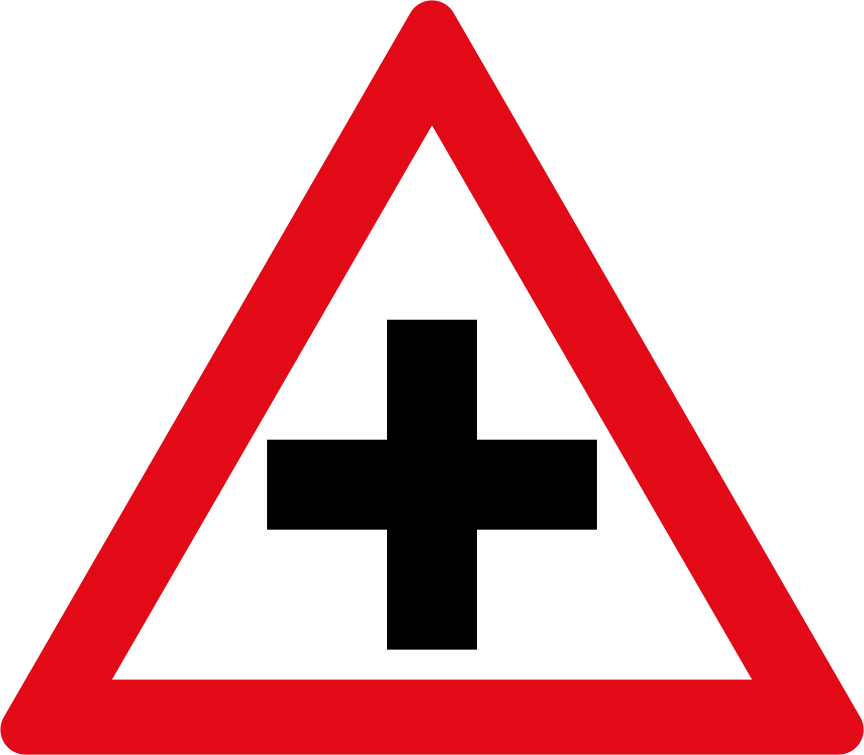
- Children may enter the road unexpectedly.
- A road crosses your route ahead.
- A steep uphill section lies ahead.
Show the answer
Answer B: A road crosses your route ahead.
Look for vehicles entering from either side and observe junction controls.
Memory tip: W101 · Crossroad ahead
All vehicle codes
2 Which response fits this sign?
- Reduce speed and be ready to stop.
- Select an appropriate gear and expect slower heavy vehicles.
- Look for vehicles entering from either side and observe junction controls.
Show the answer
Answer C: Look for vehicles entering from either side and observe junction controls.
Crossroad ahead: A road crosses your route ahead.
Memory tip: Look for vehicles entering from either side and observe junction controls.
All vehicle codes
3 Which sign group does this example belong to?
- Warning
- Command
- Prohibition
Show the answer
Answer A: Warning
Crossroad ahead is a warning sign. A road crosses your route ahead.
Memory tip: Look for vehicles entering from either side and observe junction controls.
All vehicle codes
4 What does this sign mean?
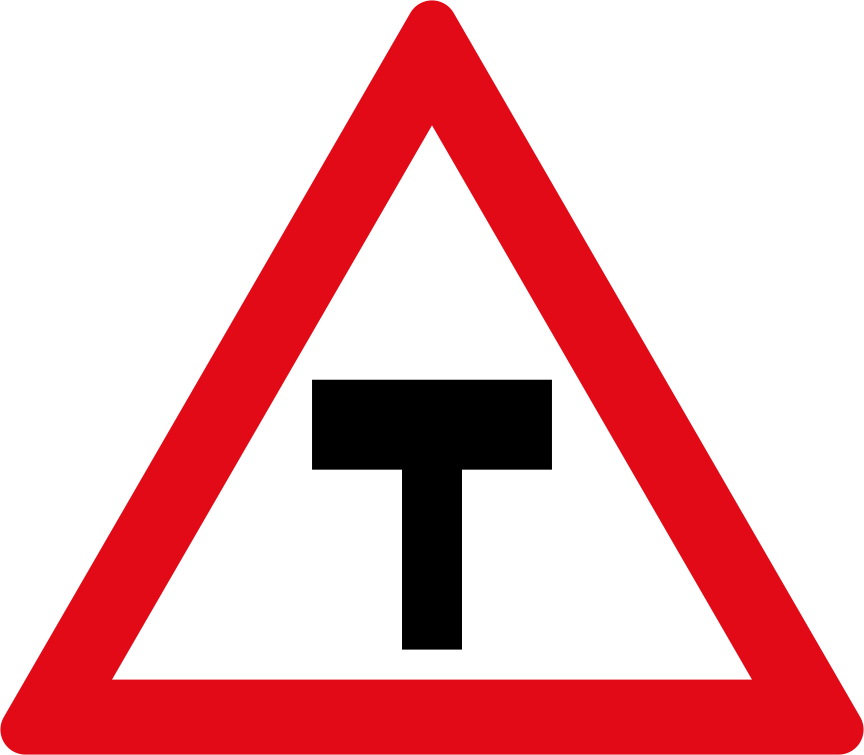
- Slow-moving heavy vehicles may be ahead.
- Your road ends at a T-junction ahead.
- A railway crossing is ahead.
Show the answer
Answer B: Your road ends at a T-junction ahead.
Reduce speed and prepare to turn left or right.
Memory tip: W104 · T-junction ahead
All vehicle codes
More signs and markings chapters
- Vehicle size and mass limits
- Pedestrian, cycle, noise and lift bans
- Reserved lanes and freeways
- Curve warnings
- Narrowing and two-way warnings
- Warnings of controls ahead
Sources: NaTIS Road Traffic Signs, June 2012, PDF p. 24–25 (names, locations, purposes and actions); iDriving K53 manual, PDF pp. 6–42 (visual comparison; text extraction incomplete); SADC artwork: assets/signs/manifest.json (per-file sources and licences).
AceK53 is an independent study aid based on public road traffic manuals and is not an official test. Always confirm requirements with your driving licence testing centre.