Signs and markings · about 6 min read
Warnings of controls ahead
Traffic lights, stop and yield signs, gates and railway crossings
What you will learn
- Use advance warnings to prepare for a control you cannot yet see.
- Remember that the legal duty starts at the control itself.
- Treat gates and railway crossings with extra caution.
Warnings of controls ahead: how to read them
Some controls are hard to see until late. A warning triangle with a small traffic light, stop sign or yield sign gives you time to slow. These signs do not create the duty to stop. They tell you that a stop sign, signal or yield sign is coming, so you can arrive at the right speed.
Gates and railway crossings bring a different danger: a train cannot swerve, and a gate can close without warning. Treat them as controls that can change quickly.
Related warnings include a motor gate across the road, which asks you to slow and check for oncoming traffic about to use the same gate, and a sign warning that traffic signals ahead are out of order. At a failed signal, slow down, yield, be ready to stop and look for an officer or a stop sign.
Key idea: The triangle prepares you. The control itself decides whether you must stop.
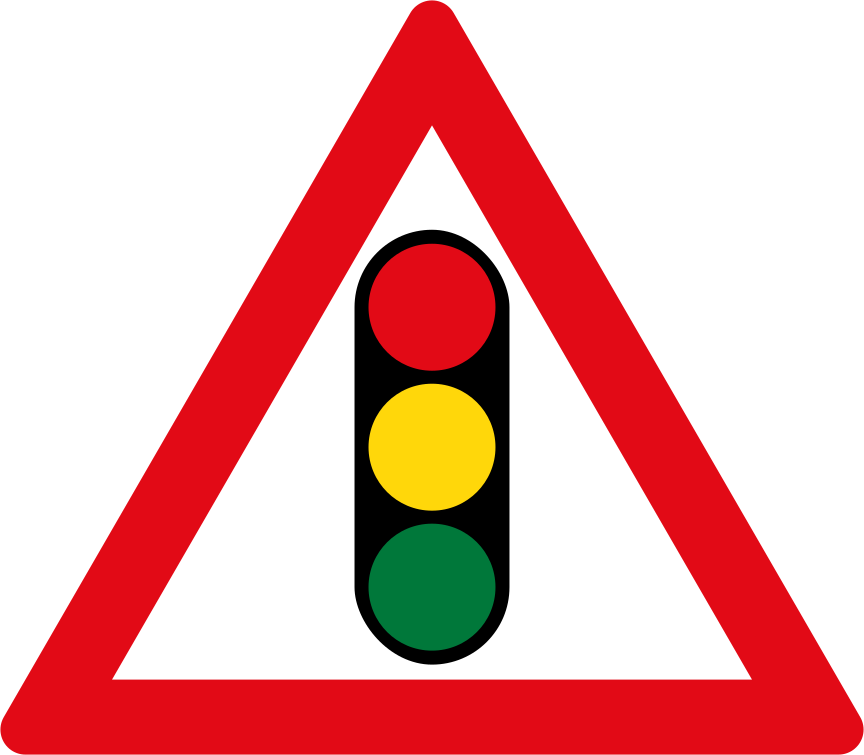
Traffic signals ahead — W301
A traffic-light-controlled junction is ahead.
Recognise it. A triangle showing a traffic light.
Where you meet it. On any road before an intersection with traffic lights, especially an isolated or new set that drivers may not expect.
What to do. Slow down immediately and be ready to stop if the light changes from green to amber. Check for pedestrians and cross-traffic that might not obey the signals.
In practice. A signal warning appears before a hill crest. You slow down and are ready to stop for a light you cannot yet see.
Easily confused. The sign only warns that lights are ahead. It does not tell you the colour or whether the set is working.
Key idea: Prepare to stop if the signal requires it.
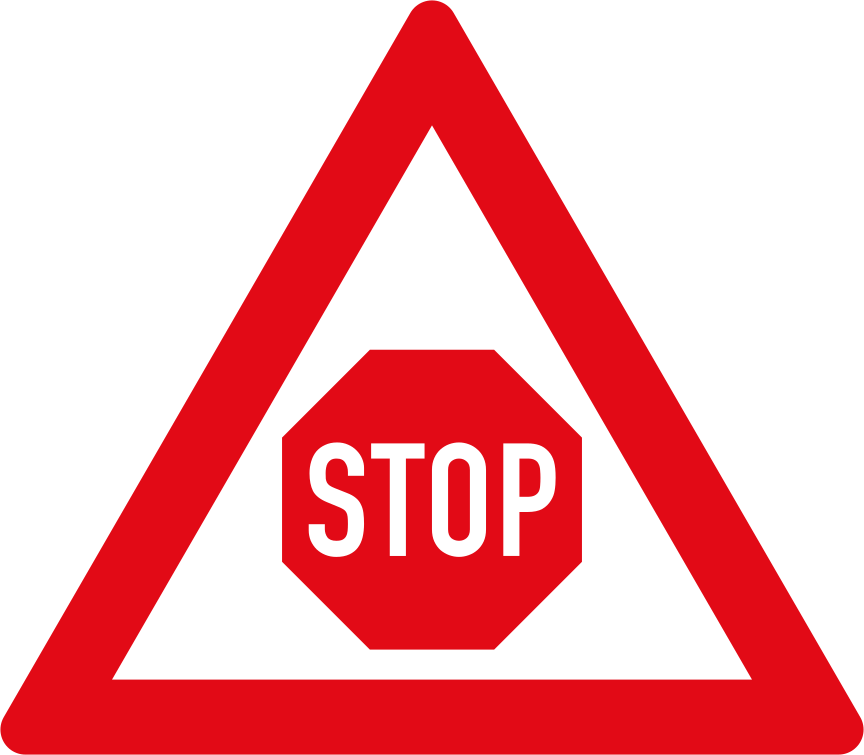
Stop ahead — W302
A stop sign is ahead.
Recognise it. A triangle showing a small stop sign.
Where you meet it. Before an intersection with a stop sign that you may not see in time.
What to do. Slow down early and be ready to stop at the actual stop sign or line.
Why it exists. A stop sign hidden by a bend or hill could surprise a driver at speed. The warning makes sure you arrive at the actual sign ready to stop.
In practice. A stop-ahead triangle appears before a bend. You ease off and prepare to stop at the line that comes into view after the bend.
Easily confused. This is a warning. The legal duty to stop begins at the stop sign itself.
Key idea: Start slowing down. The actual stop is at the stop line ahead.
Yield ahead — W303
A yield sign is ahead.
Recognise it. A triangle containing a small yield sign.
Where you meet it. Before a yield sign that is hard to see until late.
What to do. Slow down and be ready to stop if traffic is approaching at the yield.
Why it exists. A yield sign can be hidden by a bend, a crest or planting. The triangle ensures that you meet the sign already travelling at a speed that lets you give way.
In practice. A yield-ahead triangle appears. You slow, look for the sign and give way to cross-traffic when you reach it, stopping if a vehicle is close enough that your entry would force it to brake.
Easily confused. Ready to stop does not mean must stop. Prepare, then judge the junction.
Key idea: Prepare to slow down and give way.
Gate ahead — W314
A gate lies across the road ahead.
Recognise it. A triangle showing a gate or boom across the road.
Where you meet it. At a railway crossing or on the road beyond it.
What to do. Slow down and be prepared to stop if the gates are closing or closed.
Why it exists. A closed gate across a road is a hard obstacle. The sign gives you time to slow and stop without hitting it.
In practice. A gate ahead across a farm road. You slow, stop if the gate is closed and wait for someone to open it before driving on.
Easily confused. A gate may close without a train in sight. Do not try to beat it.
Key idea: Reduce speed and be ready to stop at the gate.
Railway crossing — W318
A railway crossing is ahead.
Recognise it. A triangle with a railway crossing symbol.
Where you meet it. On any road before a railway level crossing.
What to do. Slow down and look right and left for trains. If a train is coming, stop in time, but not inside the railway reserve.
Why it exists. A train cannot swerve and needs a long distance to stop. The sign exists to make sure you are ready to stop before the crossing.
In practice. A railway warning appears. You slow, look both ways and listen. If a train is coming, you stop before the railway reserve and wait.
Easily confused. Never stop on the track, even in a queue. Wait before the crossing until your exit is clear.
Key idea: Look and listen for trains. Never enter unless your exit is clear.
Warning and control
The warning is for preparation. The control is for obedience. Do not stop at the warning; slow, then stop at the actual stop line or sign.
At a railway crossing, look both ways, stop before the reserve if a train is coming, and never stop on the track.
Key idea: The triangle prepares you. The control itself decides whether you must stop.
A hidden stop sign ahead
A triangle with a stop sign appears before a bend.
- Ease off immediately.
- Find the stop line after the bend.
- Stop completely at it.
- Proceed only when the junction is clear.
Quick recap
- W301, W302 and W303 warn of controls ahead.
- The duty starts at the control.
- W318 means look for trains.
- Never stop on the railway line.
Practice questions on warnings of controls ahead
1 What does this sign mean?
- Road construction or maintenance is ahead.
- The passage ahead is only wide enough for one vehicle.
- A traffic-light-controlled junction is ahead.
Show the answer
Answer C: A traffic-light-controlled junction is ahead.
Prepare to stop if the signal requires it.
Memory tip: W301 · Traffic signals ahead
All vehicle codes
2 Which response fits this sign?
- Approach carefully and follow any priority signs.
- Prepare to stop if the signal requires it.
- Slow down, watch for workers and follow temporary controls.
Show the answer
Answer B: Prepare to stop if the signal requires it.
Traffic signals ahead: A traffic-light-controlled junction is ahead.
Memory tip: Prepare to stop if the signal requires it.
All vehicle codes
3 Which sign group does this example belong to?
- Command
- Warning
- Prohibition
Show the answer
Answer B: Warning
Traffic signals ahead is a warning sign. A traffic-light-controlled junction is ahead.
Memory tip: Prepare to stop if the signal requires it.
All vehicle codes
4 What does this sign mean?
- The road narrows from both sides ahead.
- Cyclists may be on the road ahead.
- A stop sign is ahead.
Show the answer
Answer C: A stop sign is ahead.
Start slowing down. The actual stop is at the stop line ahead.
Memory tip: W302 · Stop ahead
All vehicle codes
More signs and markings chapters
- Junction warning signs
- Curve warnings
- Narrowing and two-way warnings
- People and animals on the road
- Surface and gradient warnings
- Environmental and general hazard warnings
Sources: NaTIS Road Traffic Signs, June 2012, PDF pp. 27–29 (names, locations, purposes and actions); iDriving K53 manual, PDF pp. 6–42 (visual comparison; text extraction incomplete); SADC artwork: assets/signs/manifest.json (per-file sources and licences).
AceK53 is an independent study aid based on public road traffic manuals and is not an official test. Always confirm requirements with your driving licence testing centre.