Signs and markings · about 7 min read
Surface and gradient warnings
Hills, gravel, bumps, humps and slippery roads
What you will learn
- Prepare for steep ascents and descents.
- Adjust speed before a surface change.
- Understand why braking and steering must be smooth on slippery roads.
Surface and gradient warnings: how to read them
These warnings are about the road under your wheels. A steep gradient changes how your vehicle accelerates and stops. A change of surface, from tar to gravel, alters your steering and stopping distance. Humps, bumps and slippery sections punish late braking.
The common answer is to slow earlier than you think and keep your control inputs gentle.
Related surface warnings include a surface step, where one side of the carriageway is higher than the other. Straddling the step can pull your vehicle sideways, so avoid sudden steering. A soft shoulder warning means the edge of the road may give way, so do not drive or stop on the shoulder unless you must.
Key idea: Slow before the change. Keep braking and steering gentle.
Steep descent — W322
The road descends steeply ahead.
Recognise it. A triangle showing a steep downhill gradient.
Where you meet it. On roads where the road drops steeply, especially in mountains.
What to do. Select a lower gear before the descent, allow a longer stopping distance and do not coast in neutral. Heavy vehicles need even more room.
Why it exists. A steep descent can overheat brakes and increase speed. The sign tells you to select a lower gear before you start going down.
In practice. A steep descent sign appears on a mountain pass. You select a lower gear before the hill, check your brakes and never coast in neutral.
Easily confused. It is a warning of a gradient, not a speed limit.
Key idea: Select a suitable lower gear before the descent; do not coast in neutral.
Steep ascent — W323
A steep uphill section lies ahead.
Recognise it. A triangle showing a steep uphill gradient.
Where you meet it. On roads where the road climbs steeply, especially in mountains.
What to do. Select the right gear early and expect slow-moving traffic.
Why it exists. A steep climb slows vehicles, and slow traffic bunches up behind them. The sign helps you choose the right gear and expect queues.
In practice. A steep climb ahead. You change to a lower gear early so you do not lose speed, and you do not cross a barrier line to pass a slow truck.
Easily confused. Do not cross a no-overtaking line on the climb to pass a slow vehicle.
Key idea: Select an appropriate gear and expect slower heavy vehicles.
Slow heavy vehicles — W324
Slow-moving heavy vehicles may be ahead.
Recognise it. A triangle showing a heavy vehicle on a slope.
Where you meet it. In mountain areas where heavy vehicles descend slowly.
What to do. Slow down, and be able to stop within the distance you can see, especially on bends.
Why it exists. Heavy vehicles move slowly downhill and need a long distance to stop. The warning helps you keep a safe gap and plan your move.
In practice. Slow heavy vehicles ahead on a pass. You keep a bigger gap, expect them to brake on bends and plan your overtake only where it is legal and safe.
Easily confused. Heavy vehicles take longer to stop on a descent, so give them space.
Key idea: Adjust speed early and keep a safe following gap.
Unpaved surface — W325
An unpaved road surface lies ahead.
Recognise it. A triangle showing a tarred road changing to a gravel surface.
Where you meet it. On a tarred road before the surface becomes gravel, particularly around farms.
What to do. Slow down before the change. Watch for ditches or potholes where the surfaces meet, and expect lighter steering and longer stopping distances on gravel.
In practice. The tar ends and a gravel road begins. You slow before the joint, watch for ditches and keep a longer gap behind the vehicle ahead.
Easily confused. Slowing late and braking hard on the joint is how drivers skid.
Key idea: Reduce speed before the surface changes and avoid abrupt braking.
Uneven surface — W331
The road surface is uneven ahead.
Recognise it. A triangle showing a bumpy or uneven surface.
Where you meet it. On any road where there is a depression, a ridge or general unevenness.
What to do. Slow down to avoid potholes, without endangering other traffic.
Why it exists. Depressions, ridges and potholes can damage vehicles and upset steering. The warning lets you slow down without swerving into other traffic.
In practice. A bumpy section ahead. You slow in good time and steer around a pothole only if it is safe, instead of swerving at the last moment.
Easily confused. Do not swerve sharply to avoid a pothole; slow earlier.
Key idea: Slow down and maintain smooth control of your vehicle.
Speed hump — W332
A speed hump lies ahead.
Recognise it. A triangle showing a hump across the road.
Where you meet it. On any road with speed humps, often in urban areas.
What to do. Slow down so you can cross without damage or losing control, and release the brake as you cross.
Why it exists. Speed humps slow traffic where people may be about. The warning tells you in time so you cross at a speed that does not damage the vehicle.
In practice. A speed hump ahead. You slow so you can drive over the hump without damaging the vehicle, then release the brake as you cross.
Easily confused. Humps can be hard to see in the dark or in bad weather, so expect them after the sign.
Key idea: Reduce speed before reaching the hump.
Slippery road — W333
The road surface may have reduced grip.
Recognise it. A triangle showing a car with wavy skid marks.
Where you meet it. On any road where the surface is unusually slippery. The warning applies for the next 2 km.
What to do. Slow down. Sudden braking or harsh steering will start a skid sooner than usual.
Why it exists. Slippery surfaces make a skid likelier than usual. The sign applies for the next 2 km so that you stay gentle for the whole stretch.
In practice. The road is slippery after rain. You slow, keep your inputs smooth and increase your following gap for the next 2 km.
Easily confused. Slippery means grip may be reduced. Rain, loose material or oil can all create it.
Key idea: Reduce speed and steer and brake smoothly.
Gradient versus surface
On a gradient, select the gear before you start the climb or descent. Do not coast in neutral on a descent. On a surface change, slow before the joint, because ditches and potholes often sit where tar meets gravel.
On a slippery road, hard braking or sharp steering can start a skid sooner than usual.
Key idea: Slow before the change. Keep braking and steering gentle.
Tar ends and gravel begins
A gravel-road warning appears on a farm road.
- Slow down before the joint.
- Watch for ditches or potholes at the change.
- Keep a larger following gap on the gravel.
- Brake early and gently.
Quick recap
- Select gears before a hill.
- Do not coast in neutral.
- Slow before surface changes.
- Gentle inputs on slippery roads.
Practice questions on surface and gradient warnings
1 What does this sign mean?
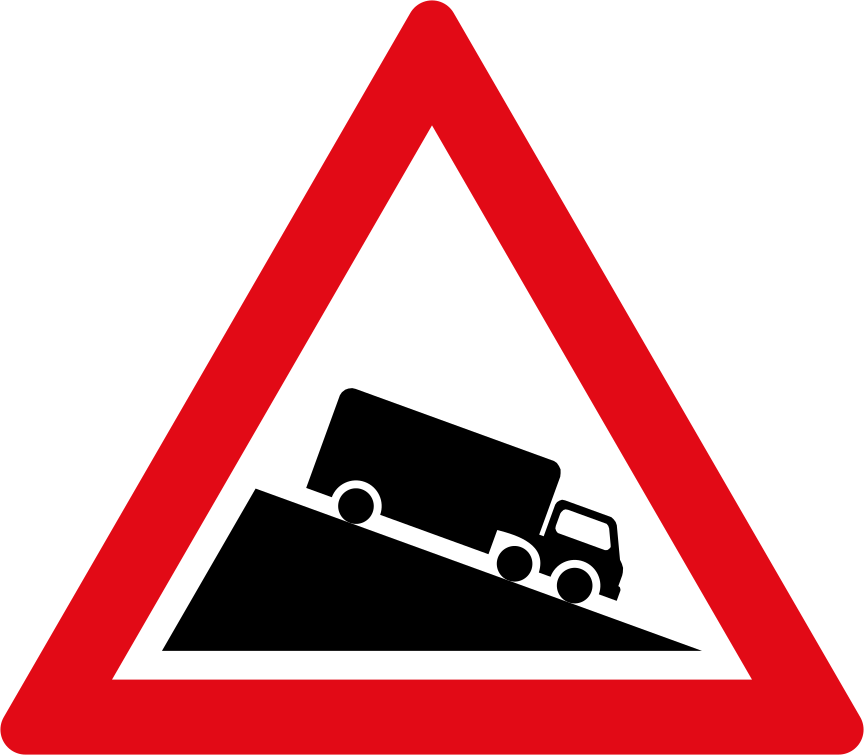
- Falling rocks may obstruct the road ahead.
- The road descends steeply ahead.
- A tunnel lies ahead.
Show the answer
Answer B: The road descends steeply ahead.
Select a suitable lower gear before the descent; do not coast in neutral.
Memory tip: W322 · Steep descent
All vehicle codes
2 Which response fits this sign?
- Look for debris and reduce speed to leave room to react.
- Prepare for changing light and visibility; observe any tunnel controls.
- Select a suitable lower gear before the descent; do not coast in neutral.
Show the answer
Answer C: Select a suitable lower gear before the descent; do not coast in neutral.
Steep descent: The road descends steeply ahead.
Memory tip: Select a suitable lower gear before the descent; do not coast in neutral.
All vehicle codes
3 Which sign group does this example belong to?
- Prohibition
- Warning
- Command
Show the answer
Answer B: Warning
Steep descent is a warning sign. The road descends steeply ahead.
Memory tip: Select a suitable lower gear before the descent; do not coast in neutral.
All vehicle codes
4 What does this sign mean?
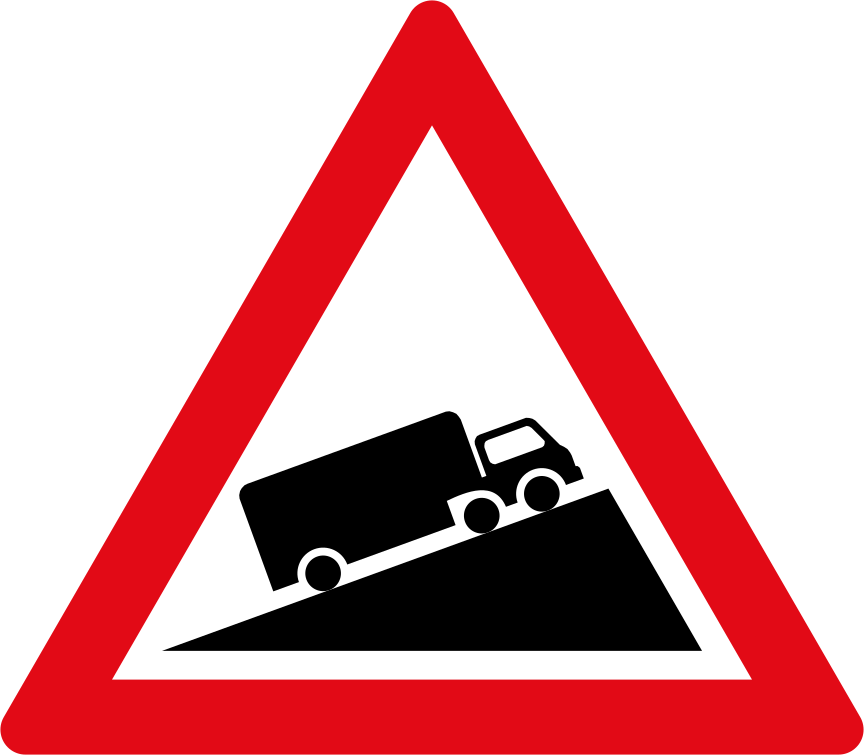
- Vehicles exceeding the displayed length may not proceed.
- A speed hump lies ahead.
- A steep uphill section lies ahead.
Show the answer
Answer C: A steep uphill section lies ahead.
Select an appropriate gear and expect slower heavy vehicles.
Memory tip: W323 · Steep ascent
All vehicle codes
More signs and markings chapters
- Narrowing and two-way warnings
- Warnings of controls ahead
- People and animals on the road
- Environmental and general hazard warnings
- Temporary roadworks signs
- Vehicle-class signs: only: part 1
Sources: NaTIS Road Traffic Signs, June 2012, PDF pp. 29–31 (names, locations, purposes and actions); iDriving K53 manual, PDF pp. 6–42 (visual comparison; text extraction incomplete); SADC artwork: assets/signs/manifest.json (per-file sources and licences).
AceK53 is an independent study aid based on public road traffic manuals and is not an official test. Always confirm requirements with your driving licence testing centre.