Signs and markings · about 7 min read
People and animals on the road
Pedestrians, children, cyclists, livestock and wildlife
What you will learn
- Recognise warnings for people and for animals.
- Know that many warnings apply for the next 2 km.
- Respond to the unpredictability of children and animals.
People and animals on the road: how to read them
These warnings protect the most vulnerable road users. They tell you that people or animals are likely to appear. Several apply for the next 2 km, so the danger covers a stretch of road, not one point.
Children and animals are unpredictable. They may run out between parked vehicles, stop suddenly or bolt in fright. The safe response is early speed reduction and enough room to stop.
The manual lists further animal and traffic warnings: elephants, warthogs and hippos in wildlife areas, horses and riders, agricultural vehicles that may cross or enter, and low-flying aircraft near airports. For aircraft, the advice is to stay calm and not to brake suddenly. The common thread is that the sign tells you what kind of surprise to expect.
Key idea: Slow before you see them. Give people and animals room and time.
Pedestrian crossing — W306
A pedestrian crossing is ahead.
Recognise it. A triangle showing a pedestrian crossing, with people on a striped zone.
Where you meet it. On any road before a marked pedestrian crossing, especially in rural areas.
What to do. Slow down and stop if someone is waiting to cross. Do not overtake a vehicle that has stopped at the crossing.
In practice. A crossing ahead on a rural road. You slow and see a mother with a pram waiting, so you stop and let her cross, then check the other side before moving on.
Easily confused. The warning announces the crossing. The priority itself is created by the crossing and the pedestrian-priority controls.
Key idea: Look for people waiting to cross or already crossing.
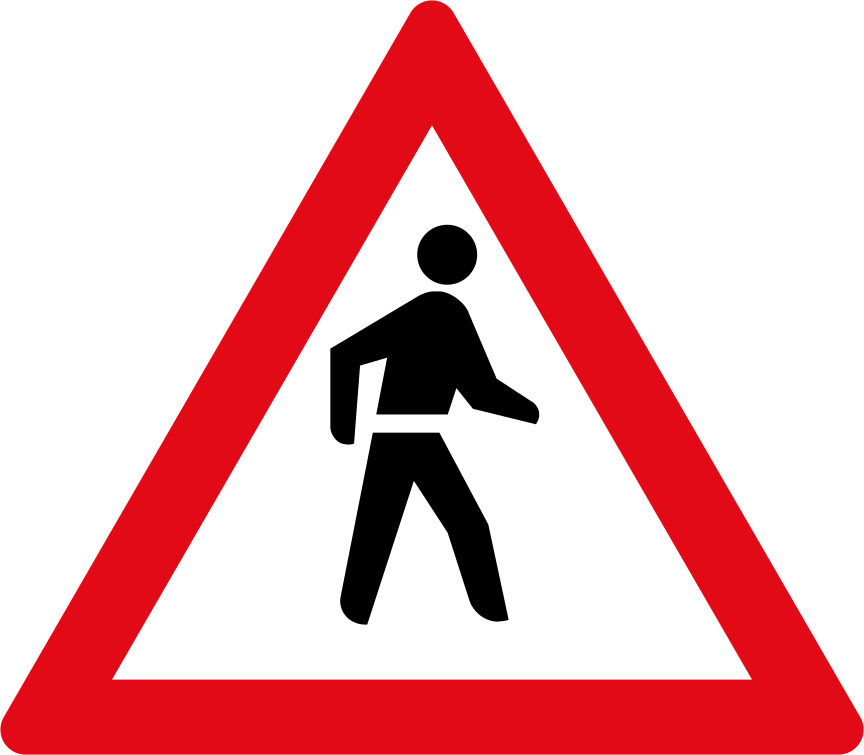
Pedestrians ahead — W307
Pedestrians may be on or near the road ahead.
Recognise it. A triangle showing a pedestrian figure.
Where you meet it. On roads where more people walk than you would normally expect. The warning applies for the next 2 km.
What to do. Slow down and watch the edges of the road for people crossing.
In practice. Many pedestrians walk along the edge of a village road. The warning applies for the next 2 km, so you stay slow throughout and give people extra space.
Easily confused. The ahead warning covers a stretch of road, not a single crossing point.
Key idea: Slow down and leave enough space.
Children ahead — W308
Children may enter the road unexpectedly.
Recognise it. A triangle showing two children.
Where you meet it. Near schools, playgrounds and sports fields.
What to do. Slow down immediately and be ready to stop. Children may run into the road without looking.
Why it exists. Children judge speed and distance poorly and may enter the road without looking. The sign exists because you cannot see them until it may be too late.
In practice. A school is nearby. You slow before the sign, scan between parked cars and are ready to stop if a child runs out.
Easily confused. Do not assume a clear pavement means a clear road. Look between parked vehicles.
Key idea: Reduce speed and be ready to stop.
Cyclists ahead — W309
Cyclists may be on the road ahead.
Recognise it. A triangle showing a bicycle.
Where you meet it. On any road where cyclists may be ahead. Applies for the next 2 km.
What to do. Slow down, give cyclists plenty of room and expect them to cross.
Why it exists. Cyclists are hard to see and have little protection. The sign tells drivers to expect them for the next 2 km.
In practice. A cycle race route is ahead. You slow down, give riders at least a wide berth and wait to overtake until it is safe.
Easily confused. It is a warning, not a cycle lane or a ban on cyclists.
Key idea: Slow down and allow safe space when passing cyclists.
Cattle ahead — W310
Cattle may cross or be on the road ahead.
Recognise it. A triangle showing cattle.
Where you meet it. On any road where cattle roam freely.
What to do. Slow down and watch for animals for the next 2 km. Stop and wait if a herd is crossing.
Why it exists. Cattle may wander onto the road at any point. The warning covers the next 2 km so that you stay alert for the whole stretch.
In practice. Cattle stand beside the road. You slow, stop when a cow steps onto the tar and wait until the herd has moved away from your path.
Easily confused. Animals are unpredictable. Do not use the horn to hurry them.
Key idea: Reduce speed and be ready to stop for animals.
Horses ahead — W311
Horses may be on or near the road ahead.
Recognise it. A triangle showing a horse.
Where you meet it. On any road where horses or riders may be present.
What to do. Slow down and give horses wide room, which will help avoid startling them.
Why it exists. Horses react to sudden noise and movement. The sign tells you to expect them so that you pass quietly and give the rider room.
In practice. A rider on a horse is ahead. You slow right down, pass wide and avoid hooting, so you do not startle the horse.
Easily confused. A loud engine or horn can startle a horse and its rider.
Key idea: Approach slowly and avoid startling horses or riders.
Sheep ahead — W312
Sheep may be on or crossing the road ahead.
Recognise it. A triangle showing sheep.
Where you meet it. On rural roads where flocks may cross.
What to do. Slow down and wait for the flock to clear before you continue.
Why it exists. Flocks move together and can fill the whole road in seconds. The sign gives you time to slow before one appears over a rise or around a bend.
In practice. A flock of sheep fills the road. You stop and wait for the herd to clear rather than pushing through it, and you move off slowly once the last animal has left the tar.
Easily confused. A flock can hide in verge grass, so reduce speed before you can see them.
Key idea: Reduce speed and wait for animals to clear the road.
Wild animals ahead — W313
Wild animals may enter the road ahead.
Recognise it. A triangle showing a wild animal.
Where you meet it. Mostly on rural roads, especially near nature reserves.
What to do. Slow down and watch the verges, particularly at dusk and dawn. Stop if an animal is in your path.
Why it exists. Wild animals can be large and fast. The sign tells you to watch the verges, because a collision with one can be serious.
In practice. At dusk, a wild animal warning appears near a reserve. You lower your speed, scan the verges and brake gently if an animal steps out.
Easily confused. Do not swerve violently to avoid an animal; brake in a straight line where you can.
Key idea: Watch the roadside and adjust speed to allow a safe response.
Predictable and unpredictable
A pedestrian crossing is a known place. A warning of pedestrians or cyclists covers a stretch where they may appear anywhere. Domestic animals (cattle, horses, sheep) and wild animals behave differently: horses can be startled by noise, and wild animals are most active at dusk and dawn.
Never use the horn to hurry people or livestock. Stop and wait if a herd crosses.
Key idea: Slow before you see them. Give people and animals room and time.
Cattle on a country road
A cattle warning appears, then a herd stands across the road.
- Slow down as soon as you see the sign.
- Stop when the herd is in your path.
- Wait until all animals have crossed.
- Move off slowly and watch for stragglers.
Quick recap
- People and animals can appear without warning.
- Many warnings cover the next 2 km.
- Do not hurry livestock with the horn.
- Children need extra room.
Practice questions on people and animals on the road
1 What does this sign mean?
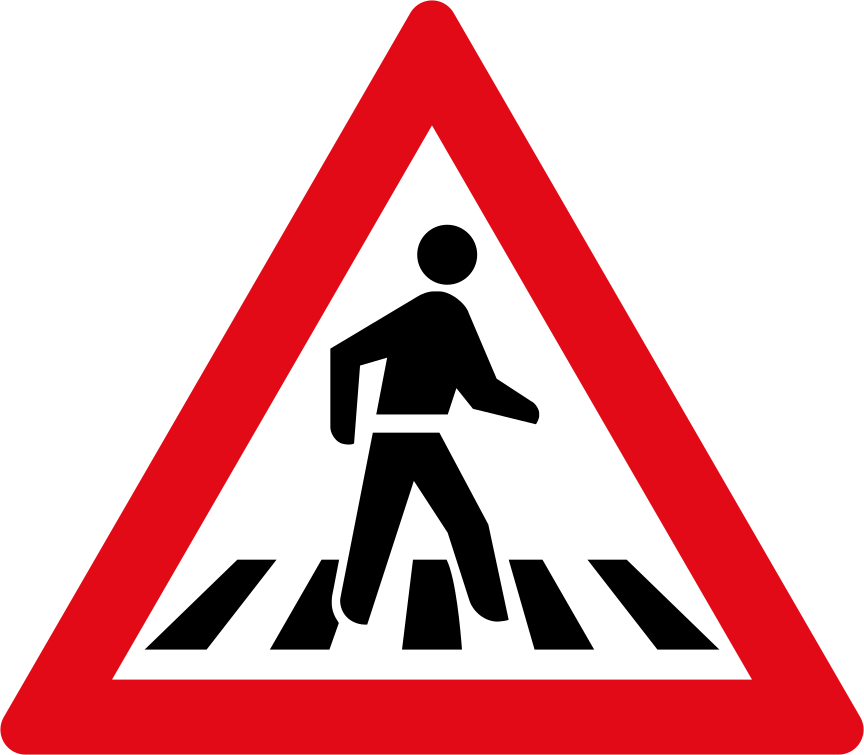
- Horses may be on or near the road ahead.
- A pedestrian crossing is ahead.
- The road narrows from the left ahead.
Show the answer
Answer B: A pedestrian crossing is ahead.
Look for people waiting to cross or already crossing.
Memory tip: W306 · Pedestrian crossing
All vehicle codes
2 Which response fits this sign?
- Check traffic and adjust position safely as the road narrows.
- Look for people waiting to cross or already crossing.
- Approach slowly and avoid startling horses or riders.
Show the answer
Answer B: Look for people waiting to cross or already crossing.
Pedestrian crossing: A pedestrian crossing is ahead.
Memory tip: Look for people waiting to cross or already crossing.
All vehicle codes
3 Which sign group does this example belong to?
- Command
- Warning
- Prohibition
Show the answer
Answer B: Warning
Pedestrian crossing is a warning sign. A pedestrian crossing is ahead.
Memory tip: Look for people waiting to cross or already crossing.
All vehicle codes
4 What does this sign mean?
- The road surface is uneven ahead.
- Sheep may be on or crossing the road ahead.
- Pedestrians may be on or near the road ahead.
Show the answer
Answer C: Pedestrians may be on or near the road ahead.
Slow down and leave enough space.
Memory tip: W307 · Pedestrians ahead
All vehicle codes
More signs and markings chapters
- Curve warnings
- Narrowing and two-way warnings
- Warnings of controls ahead
- Surface and gradient warnings
- Environmental and general hazard warnings
- Temporary roadworks signs
Sources: NaTIS Road Traffic Signs, June 2012, PDF p. 28–29 (names, locations, purposes and actions); iDriving K53 manual, PDF pp. 6–42 (visual comparison; text extraction incomplete); SADC artwork: assets/signs/manifest.json (per-file sources and licences).
AceK53 is an independent study aid based on public road traffic manuals and is not an official test. Always confirm requirements with your driving licence testing centre.