Signs and markings · about 4 min read
Temporary roadworks signs
Yellow signs and what they tell you about a changed road
What you will learn
- Recognise that a yellow background means temporary.
- Slow down for people and equipment on the road.
- Follow temporary instructions rather than old habits.
Temporary roadworks signs: how to read them
A yellow background marks a temporary sign. It tells you that normal standards do not apply and you must give more attention to the circumstances. Temporary signs may be used for minutes, hours or months at roadworks, collision scenes and school crossings.
Temporary signs carry a T before their number. Their meaning is the same as the permanent sign, but they apply only for a short time.
The manual also lists temporary signs for particular situations. They use the same shapes as permanent ones, so a yellow triangle warns exactly what its permanent version would, only for a short time.
Key idea: Yellow means temporary. Follow what you see now, not what you remember.
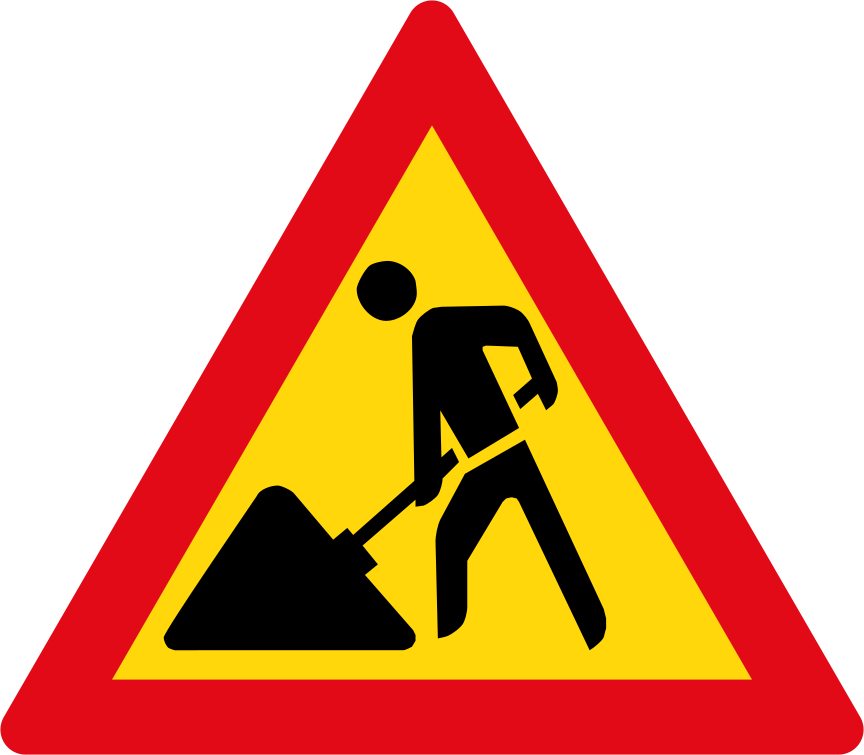
Roadworks — TW336
Road construction or maintenance is ahead.
Recognise it. A triangle on a yellow background, the colour used for temporary signs.
Where you meet it. On any road before temporary construction or maintenance.
What to do. Slow down, watch for other temporary signs and for people regulating traffic or crossing the road.
Why it exists. Roadworks change the road for a short time and put people near moving traffic. The sign tells you the usual standards do not apply.
In practice. You drive a familiar road. A yellow sign announces roadworks, so you slow down, follow the temporary lane markings and keep clear of workers.
Easily confused. Yellow means temporary. Do not assume normal speeds, lanes or priorities still apply.
Key idea: Slow down, watch for workers and follow temporary controls.
Other temporary warnings you may meet
A grader-working sign warns that the full width of the road may not be available and that sand or gravel may affect handling, so pass slowly. A loose-stones sign warns that oncoming vehicles may throw up stones that damage your vehicle, and that braking and turning will be affected. A surface-step sign warns that one side of the carriageway is higher than the other, so avoid sudden steering. A soft-shoulder sign tells you not to drive or stop on the shoulder.
At collision scenes a warning sign tells you that wreckage, injured people, rescue teams or glass may be on the road. Slow immediately, look for whoever is controlling traffic and concentrate on the route you must follow. Do not stop out of curiosity if enough help is already there.
Key idea: Temporary signs describe the specific hazard. Read each one rather than assuming it matches the last.
People controlling traffic
Several temporary signs warn that a person is directing traffic. A traffic-officer-ahead sign tells you to slow down and be ready to stop if the officer instructs you. A scholar-patrol sign warns of children crossing under supervision, so look for the stop sign the patrol displays. A flashing blue light sign warns of a collision scene, roadblock or similar police activity and tells you to be ready to stop at the temporary stop sign that follows or on a police officer’s demand.
A sign warning that a hand-held STOP/GO control is ahead tells you to slow down and get ready to stop. A barricade sign warns that part of the road is closed; do not try to drive past, and look for signs showing an alternative route.
Key idea: Where a person controls traffic, their instruction overrides your habits and, at times, other signs.
Old habits and new lanes
At roadworks the lane layout, speed limit and priorities may differ from what you know. Follow the temporary signs and anyone controlling traffic, not what you remember.
A hand-held STOP/GO board (R1.5) is common at roadworks. Obey the face turned towards you.
Key idea: Yellow means temporary. Follow what you see now, not what you remember.
A familiar road with roadworks
A yellow roadworks sign appears on your daily route.
- Slow down immediately.
- Watch for workers and equipment.
- Follow lane signs and any traffic controller.
- Do not drive through barriers.
Quick recap
- Yellow means temporary.
- A T before the number marks a temporary sign.
- Workers may be on the road.
- Obey a STOP/GO board.
Practice questions on temporary roadworks signs
1 What does this sign mean?
- An unprotected jetty edge or river bank lies ahead.
- Road construction or maintenance is ahead.
- A vehicle-length restriction applies ahead.
Show the answer
Answer B: Road construction or maintenance is ahead.
Slow down, watch for workers and follow temporary controls.
Memory tip: TW336 · Roadworks
All vehicle codes
2 Which response fits this sign?
- Slow down, watch for workers and follow temporary controls.
- Approach slowly and keep clear of the unprotected edge.
- Check that your vehicle combination meets the restriction.
Show the answer
Answer A: Slow down, watch for workers and follow temporary controls.
Roadworks: Road construction or maintenance is ahead.
Memory tip: Slow down, watch for workers and follow temporary controls.
All vehicle codes
3 Which sign group does this example belong to?
- Temporary
- Warning
- Command
Show the answer
Answer A: Temporary
Roadworks is a temporary sign. Road construction or maintenance is ahead.
Memory tip: Slow down, watch for workers and follow temporary controls.
All vehicle codes
More signs and markings chapters
- People and animals on the road
- Surface and gradient warnings
- Environmental and general hazard warnings
- Vehicle-class signs: only: part 1
- Vehicle-class signs: only: part 2
- Prohibition signs
Sources: NaTIS Road Traffic Signs, June 2012, PDF pp. 3–4, 31 (names, locations, purposes and actions); iDriving K53 manual, PDF pp. 6–42 (visual comparison; text extraction incomplete); SADC artwork: assets/signs/manifest.json (per-file sources and licences).
AceK53 is an independent study aid based on public road traffic manuals and is not an official test. Always confirm requirements with your driving licence testing centre.