Signs and markings · about 6 min read
Environmental and general hazard warnings
Rocks, wind, water edges, tunnels and general danger
What you will learn
- Respond to rock fall, wind and water-edge warnings.
- Prepare for tunnels.
- Read a general warning with its plate.
Environmental and general hazard warnings: how to read them
The hazards in this group come from the surroundings rather than the road surface: rocks that may fall, wind that may push, water at the road end, and the sudden dark of a tunnel. A general warning exists for dangers that have no special symbol, and its plate tells you what the danger is.
In all cases, slow enough that you can stop within the distance you can see.
Other hazard warnings include a drift, where the road may be flooded. If you do not know how deep the water is, stop; if it is passable, drive through slowly. A reduced-visibility sign warns of fog or smoke, and a congestion sign warns of slow traffic ahead.
Key idea: Slow so you can stop in the distance you can see, and read any supporting plate.
Falling rocks — W334
Falling rocks may obstruct the road ahead.
Recognise it. A triangle showing rocks tumbling from the left side.
Where you meet it. In mountain areas where rock falls occur.
What to do. Slow down enough to stop within your sight distance if a fall occurs or has occurred. Rain makes falls more likely.
Why it exists. Rock falls are a danger in mountain cuttings, especially after rain. The sign asks you to leave yourself enough distance to stop.
In practice. A rock fall warning on a rain-soaked mountain road. You slow, keep a bigger gap from the vehicle ahead and watch the surface for stones.
Easily confused. Look at the carriageway for rocks that have already fallen.
Key idea: Look for debris and reduce speed to leave room to react.
Falling rocks — W335
Falling rocks may obstruct the road ahead.
Recognise it. A triangle showing rocks tumbling from the right side.
Where you meet it. In mountain areas where rocks may fall from the right.
What to do. Reduce speed further in rain and be ready to stop for fallen rocks.
Why it exists. Rocks can appear without warning, and rain makes falls more likely. The sign asks for a speed that lets you stop in the distance you can see.
In practice. Rocks may fall from the right. You slow down and move slightly away from the right edge, scanning the road for debris.
Easily confused. The side is shown by the artwork. Do not bunch up behind another vehicle.
Key idea: Look for debris and reduce speed to leave room to react.
General danger — W339
A danger requiring extra caution lies ahead.
Recognise it. A triangle with an exclamation mark.
Where you meet it. On any road, often with a plate explaining the danger.
What to do. Slow down and look for anything on or beside the road that could make you change speed or direction.
In practice. A general warning with a plate saying there is a drift ahead. You slow down, read the plate and look for anything that could make you change speed or direction.
Easily confused. It is a general warning. Read any supporting plate to learn what the danger is.
Key idea: Read any supplementary plate and approach carefully.
Unprotected water edge — W348
An unprotected jetty edge or river bank lies ahead.
Recognise it. A triangle showing a vehicle driving off the end of a jetty or river bank.
Where you meet it. On roads close to water or harbours.
What to do. Slow down and look for the end of the road so you can stop in time.
Why it exists. A road that leads to a jetty or river bank can end in deep water. The sign gives you time to stop before the end.
In practice. A road ends at a harbour edge at night. You slow, watch for the end of the road and stop in time.
Easily confused. Unprotected edges are dangerous at night. Do not rely on headlights alone.
Key idea: Approach slowly and keep clear of the unprotected edge.
Crosswinds — W349
Strong crosswinds may affect vehicles ahead.
Recognise it. A triangle showing a windsock.
Where you meet it. On roads in exposed rural and mountainous areas.
What to do. Check whether a strong wind is blowing and from which direction. Any shielding from a truck, bridge or cutting changes the force on your vehicle, so adjust your steering in time.
Why it exists. Strong gusts can force a vehicle off course, particularly in exposed places. The warning tells you to expect them and to steer early.
In practice. A crosswind warning appears before an exposed bridge. You slow down, hold the steering firmly and correct drift gently as a gust hits.
Easily confused. The wind can push a vehicle sideways when it leaves a sheltered patch.
Key idea: Slow down and allow for sideways movement, especially near exposed areas.
Tunnel ahead — W319
A tunnel lies ahead.
Recognise it. A triangle showing a tunnel entrance.
Where you meet it. On any road, especially in mountain areas.
What to do. Slow down and switch on your dipped headlights. Study references also advise against overtaking in or near tunnels.
Why it exists. Moving from daylight into a tunnel makes it hard to see for a moment. The sign gives you time to slow and put on your headlights first.
In practice. A tunnel ahead. You slow, switch on dipped headlights before entering, and keep a steady gap from the vehicle ahead until your eyes adjust.
Easily confused. Your eyes need time to adjust to the dark inside a tunnel.
Key idea: Prepare for changing light and visibility; observe any tunnel controls.
Stopping within sight distance
Rock falls are more likely in rain, so reduce speed further when it is wet. Crosswinds can strike when you leave a sheltered patch such as a cutting or the lee of a truck. Water edges are dangerous at night.
A tunnel needs dipped headlights and time for your eyes to adjust.
Key idea: Slow so you can stop in the distance you can see, and read any supporting plate.
A crosswind on an exposed bridge
A crosswind warning appears before an exposed bridge.
- Slow down and keep both hands on the wheel.
- Allow for a sudden push as you leave shelter.
- Keep a bigger gap from large vehicles.
- Steer smoothly to correct drift.
Quick recap
- Rain makes rock falls more likely.
- Wind pushes when shelter ends.
- Tunnels need dipped headlights.
- A general warning needs its plate.
Practice questions on environmental and general hazard warnings
1 What does this sign mean?
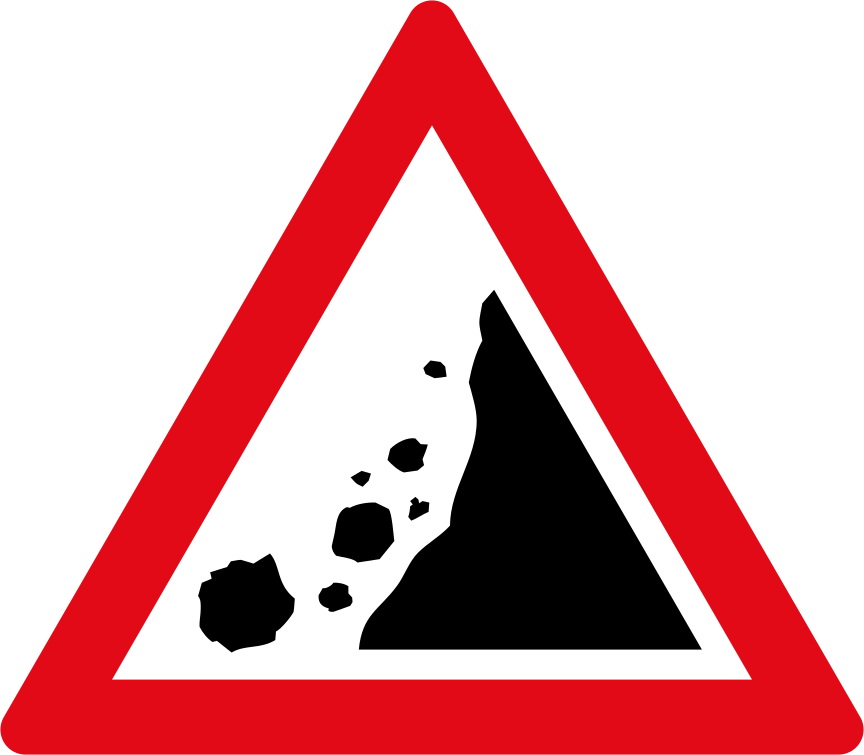
- Falling rocks may obstruct the road ahead.
- Traffic may travel only in the direction shown by the arrow.
- A side road joins ahead as shown.
Show the answer
Answer A: Falling rocks may obstruct the road ahead.
Look for debris and reduce speed to leave room to react.
Memory tip: W334 · Falling rocks
All vehicle codes
2 Which response fits this sign?
- Read the arrow before entering the roadway.
- Check the side-road approach and observe junction controls.
- Look for debris and reduce speed to leave room to react.
Show the answer
Answer C: Look for debris and reduce speed to leave room to react.
Falling rocks: Falling rocks may obstruct the road ahead.
Memory tip: Look for debris and reduce speed to leave room to react.
All vehicle codes
3 Which sign group does this example belong to?
- Command
- Warning
- Prohibition
Show the answer
Answer B: Warning
Falling rocks is a warning sign. Falling rocks may obstruct the road ahead.
Memory tip: Look for debris and reduce speed to leave room to react.
All vehicle codes
4 What does this sign mean?
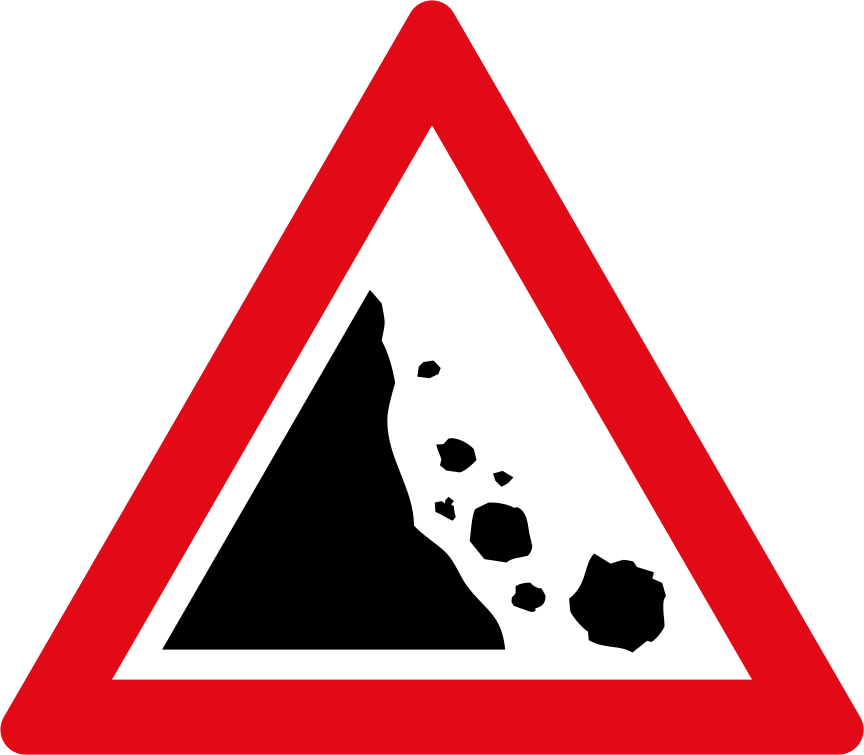
- Side-road junctions are staggered ahead.
- Falling rocks may obstruct the road ahead.
- Vehicles exceeding the displayed gross mass may not proceed.
Show the answer
Answer B: Falling rocks may obstruct the road ahead.
Look for debris and reduce speed to leave room to react.
Memory tip: W335 · Falling rocks
All vehicle codes
More signs and markings chapters
- Warnings of controls ahead
- People and animals on the road
- Surface and gradient warnings
- Temporary roadworks signs
- Vehicle-class signs: only: part 1
- Vehicle-class signs: only: part 2
Sources: NaTIS Road Traffic Signs, June 2012, PDF pp. 30–32 (names, locations, purposes and actions); iDriving K53 manual, PDF pp. 6–42 (visual comparison; text extraction incomplete); SADC artwork: assets/signs/manifest.json (per-file sources and licences).
AceK53 is an independent study aid based on public road traffic manuals and is not an official test. Always confirm requirements with your driving licence testing centre.