Signs and markings · about 6 min read
Narrowing and two-way warnings
Where the road narrows, the structure is narrow or traffic changes direction
What you will learn
- Tell a narrow bridge from a one-vehicle structure.
- Adjust position when the road narrows from one or both sides.
- Recognise when a one-way road becomes two-way.
Narrowing and two-way warnings: how to read them
These signs warn that the space for traffic is changing. Sometimes the road narrows from one side, sometimes from both. A narrow bridge or a one-vehicle structure restricts how traffic can pass.
Slow down, change position as the space reduces and decide in good time whether you or an approaching vehicle will go first.
The manual also describes a warning for a lane that ends on a multi-lane road. When a lane ends, move to the continuing lane in good time and give way to traffic already in it. Leaving the move late forces other drivers to brake.
Key idea: Ask whether two vehicles can pass. If not, decide who waits before you reach the structure.
Two-way traffic — W212
Oncoming traffic uses the road ahead.
Recognise it. A triangle showing two opposing arrows to show traffic travelling both ways.
Where you meet it. On a one-way road, before it turns into a two-way road.
What to do. Keep to the left, take more care when overtaking and expect vehicles coming towards you.
In practice. You leave a one-way street and see the two-way warning. You move to the left side of the road and watch for vehicles coming the other way.
Easily confused. It warns of a change in the road layout; it is not about a speed or a junction.
Key idea: Keep left and be alert for vehicles approaching in the opposite direction.
Narrow bridge — W326
A narrow bridge lies ahead.
Recognise it. A triangle showing the road narrowing as it crosses a bridge.
Where you meet it. On any road before a bridge that is narrower than the approach.
What to do. Slow down. If a vehicle is coming the other way, try not to cross at the same moment.
In practice. A narrow bridge ahead. You see a vehicle approaching the other end, so you ease off and let it cross first rather than meeting in the middle.
Easily confused. Not the same as a one-vehicle structure (W327), where only a single vehicle can pass at a time.
Key idea: Reduce speed, check oncoming traffic and obey priority controls.
Single-vehicle passage — W327
The passage ahead is only wide enough for one vehicle.
Recognise it. A triangle showing a structure only wide enough for one vehicle at a time.
Where you meet it. On any road before a narrow structure.
What to do. Slow down if there is oncoming traffic, stop at least 6 metres before the structure and yield to the other vehicle.
In practice. A one-lane causeway. A taxi is halfway across. You stop at least 6 metres before the structure and wait until it has cleared.
Easily confused. The key difference from W326 is that there is no room to pass. One side waits.
Key idea: Approach carefully and follow any priority signs.
Road narrows — W328
The road narrows from both sides ahead.
Recognise it. A triangle showing the road narrowing symmetrically from both sides.
Where you meet it. On any road before a narrowed section.
What to do. Slow down and move your position on the carriageway, because oncoming vehicles will pass close to you.
Why it exists. When both sides of the road close in, vehicles pass closer together. The sign asks you to slow and give oncoming traffic room.
In practice. The road narrows on both sides. You slow, keep to your side and move away from the kerb to leave room for oncoming vehicles.
Easily confused. It narrows both ways, unlike W329 and W330 where one side only closes in.
Key idea: Reduce speed and allow room for other road users.
Road narrows on right — W329
The road narrows from the right ahead.
Recognise it. A triangle showing the road narrowing from the right.
Where you meet it. On any road before the right-hand edge closes in.
What to do. Slow down and adjust your position as the space reduces on your right.
Why it exists. When the right edge closes in, there is less room for vehicles to pass one another. The warning lets you plan your position before the space shrinks.
In practice. The road narrows from the right. You slow and hold a line further left, away from the narrowing edge, leaving room if a truck approaches from the front.
Easily confused. Read which side is narrowing. The two one-sided versions are mirror images.
Key idea: Check traffic and prepare for less road space.
Road narrows on left — W330
The road narrows from the left ahead.
Recognise it. A triangle showing the road narrowing from the left.
Where you meet it. On any road before the left-hand edge closes in.
What to do. Slow down and adjust your lane position as the space on your left reduces.
Why it exists. When the left edge closes in, your lane position has to change. The sign tells you to adjust gently instead of finding the narrowing at speed.
In practice. The road narrows from the left. You slow, keep a straight line and avoid drifting towards the centre, even if the road ahead looks empty.
Easily confused. Do not drift into the opposite lane; reduce speed and keep a straight line.
Key idea: Check traffic and adjust position safely as the road narrows.
Can two vehicles pass?
On a narrow bridge (W326) two vehicles can still pass if both are careful, but it is better not to meet on the bridge. At a one-vehicle structure (W327) only one can pass, so the other must wait at least 6 metres back.
W328, W329 and W330 describe where the narrowing comes from. W212 warns that a one-way road is about to become two-way, so oncoming vehicles will appear.
Key idea: Ask whether two vehicles can pass. If not, decide who waits before you reach the structure.
A one-vehicle structure
You see W327 and a truck approaching the structure from the other side.
- Slow down and keep at least 6 metres back.
- Yield to the truck if it is already at or on the structure.
- Move only when the structure is clear.
- Keep a steady speed as you cross.
Quick recap
- Bridge: pass carefully.
- One-vehicle structure: stop 6 m away and yield.
- Read which side narrows.
- Two-way ahead means oncoming traffic.
Practice questions on narrowing and two-way warnings
1 What does this sign mean?
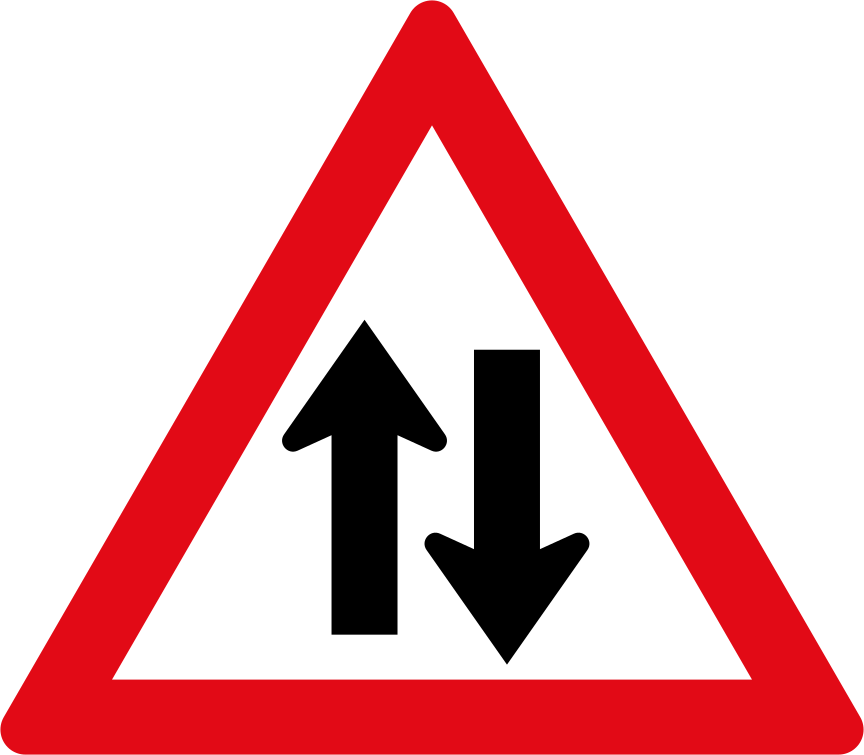
- A narrow bridge lies ahead.
- The road surface may have reduced grip.
- Oncoming traffic uses the road ahead.
Show the answer
Answer C: Oncoming traffic uses the road ahead.
Keep left and be alert for vehicles approaching in the opposite direction.
Memory tip: W212 · Two-way traffic
All vehicle codes
2 Which response fits this sign?
- Reduce speed, check oncoming traffic and obey priority controls.
- Reduce speed and steer and brake smoothly.
- Keep left and be alert for vehicles approaching in the opposite direction.
Show the answer
Answer C: Keep left and be alert for vehicles approaching in the opposite direction.
Two-way traffic: Oncoming traffic uses the road ahead.
Memory tip: Keep left and be alert for vehicles approaching in the opposite direction.
All vehicle codes
3 Which sign group does this example belong to?
- Command
- Prohibition
- Warning
Show the answer
Answer C: Warning
Two-way traffic is a warning sign. Oncoming traffic uses the road ahead.
Memory tip: Keep left and be alert for vehicles approaching in the opposite direction.
All vehicle codes
4 What does this sign mean?
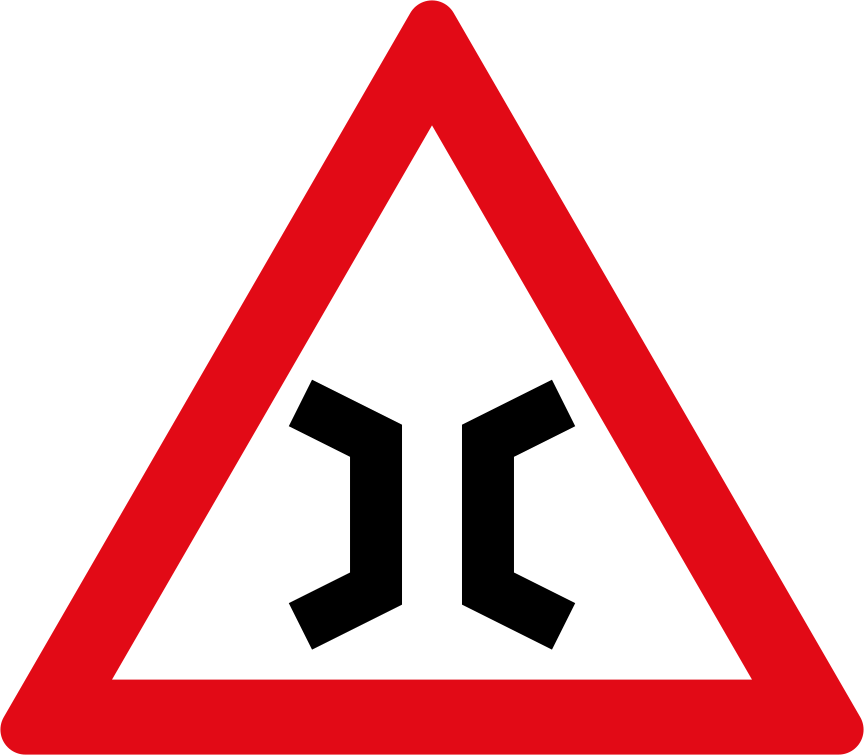
- A left turn is prohibited at the junction ahead.
- A narrow bridge lies ahead.
- A danger requiring extra caution lies ahead.
Show the answer
Answer B: A narrow bridge lies ahead.
Reduce speed, check oncoming traffic and obey priority controls.
Memory tip: W326 · Narrow bridge
All vehicle codes
More signs and markings chapters
- Reserved lanes and freeways
- Junction warning signs
- Curve warnings
- Warnings of controls ahead
- People and animals on the road
- Surface and gradient warnings
Sources: NaTIS Road Traffic Signs, June 2012, PDF pp. 26, 30 (names, locations, purposes and actions); iDriving K53 manual, PDF pp. 6–42 (visual comparison; text extraction incomplete); SADC artwork: assets/signs/manifest.json (per-file sources and licences).
AceK53 is an independent study aid based on public road traffic manuals and is not an official test. Always confirm requirements with your driving licence testing centre.