Signs and markings · about 4 min read
Curve warnings
Gentle and sharp bends, and how to take them
What you will learn
- Distinguish gentle from sharp curves.
- Read the direction of the bend.
- Reduce speed before the bend, not inside it.
Curve warnings: how to read them
The arrow in a curve warning is a picture of the road ahead. A gentle curve has a shallow arrow. A sharp curve has a tight bend. Left and right versions exist, so read the direction.
The skill is the same for all: slow before the curve so you can steer through at a safe speed or stop within the distance you can see. Braking hard in a bend is what causes skids.
Related signs include the winding road and hairpin bend warnings, which add that more curves may follow without further warning. When you see a bend sign on a mountain road, plan for the road after the first curve as well as the curve itself.
Key idea: Slow before the bend. Steer smoothly through it.
Gentle curve ahead — W202
The road curves ahead in the direction shown.
Recognise it. A triangle with a gentle bend arrow. A left and a right version exist.
Where you meet it. On any public road before a long, gentle curve.
What to do. Slow so that you can take the curve safely or stop within the distance you can see.
In practice. A gentle curve appears. You lift off the accelerator before the bend, keep a steady line and accelerate only after you can see out of it.
Easily confused. Gentle does not mean harmless: a wet road or high speed can still make a gentle curve dangerous.
Key idea: Adjust speed before the curve.
Curve ahead — W203
The road changes direction ahead.
Recognise it. A triangle with a curve arrow, the paired version of W202.
Where you meet it. On any public road before a gentle curve in the direction shown.
What to do. Reduce speed before you enter the bend, so you steer rather than brake in it.
In practice. A gentle curve warning on a wet road. You slow earlier than you would on a dry one, and you avoid braking in the curve.
Easily confused. Read the arrow direction. A curve to the right needs your position and speed adjusted differently from one to the left.
Key idea: Reduce speed before the bend, following the direction shown.
Sharp curve ahead — W204
A sharp bend lies ahead in the direction shown.
Recognise it. A triangle showing a tight bend arrow.
Where you meet it. On any public road before a sharp curve.
What to do. Slow down well before the curve so that you can pass through it safely or stop within the distance you can see.
In practice. A sharp bend ahead. You brake on the straight, change down if needed and steer through at a speed that lets you stop in the distance you can see.
Easily confused. The tighter the arrow, the lower the safe speed. Do not brake hard inside the bend.
Key idea: Reduce speed and select a suitable gear before the bend.
Sharp curve ahead — W205
A sharp bend lies ahead in the direction shown.
Recognise it. A triangle with a tight bend arrow, the opposite hand to W204.
Where you meet it. On any public road before a sharp curve in the direction shown.
What to do. Prepare before the bend: slow, choose a suitable gear and steer smoothly through.
Why it exists. A tight bend with limited visibility can hide oncoming traffic. The sign asks for a speed that allows you to stop in the distance you can see.
In practice. A sharp bend, opposite hand. You keep to your lane and slow early, because oncoming traffic may use the middle of the road.
Easily confused. A sharp curve often hides oncoming traffic. Keep to your own side of the road.
Key idea: Prepare before the bend and steer smoothly.
Gentle versus sharp
A gentle curve (W202, W203) still needs a speed that suits the road surface and visibility. A sharp curve (W204, W205) needs a lower speed and a gear chosen before you enter.
Do not cross into the opposing lane to straighten a bend. Oncoming vehicles can appear without warning.
Key idea: Slow before the bend. Steer smoothly through it.
A sharp curve on a wet road
A sharp-curve warning appears as it begins to rain.
- Slow down on the straight before the bend.
- Select a suitable gear.
- Keep to your side and steer smoothly.
- Accelerate gently as you leave the bend.
Quick recap
- Read the arrow direction.
- Slow before entering.
- Stay on your side.
- Wet roads need even lower speeds.
Practice questions on curve warnings
1 What does this sign mean?
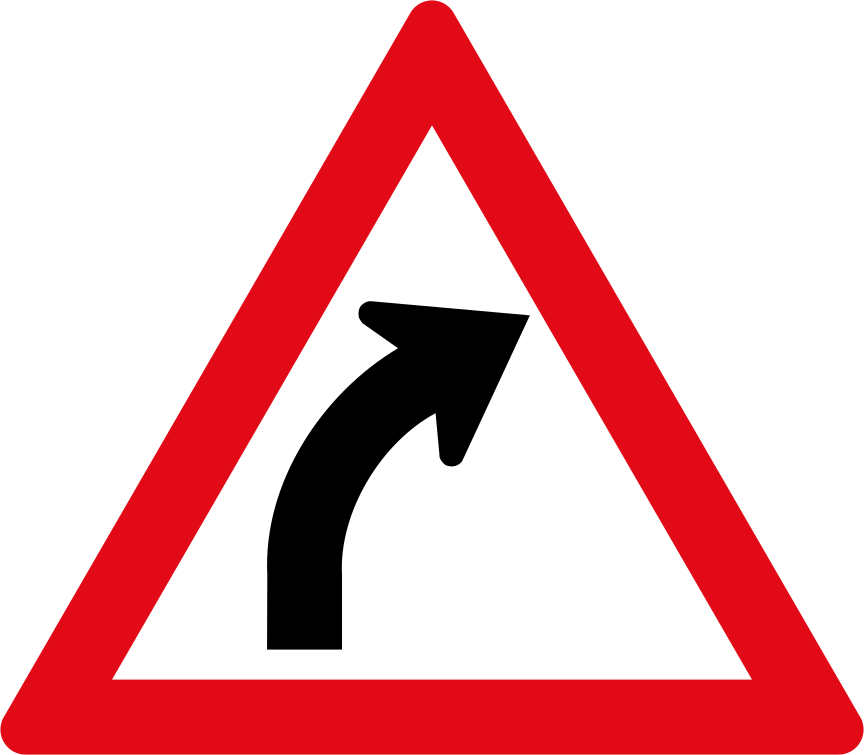
- The road curves ahead in the direction shown.
- You must turn left at the junction ahead.
- This route is for pedestrians and cyclists, not motor vehicles.
Show the answer
Answer A: The road curves ahead in the direction shown.
Adjust speed before the curve.
Memory tip: W202 · Gentle curve ahead
All vehicle codes
2 Which response fits this sign?
- Adjust speed before the curve.
- Position correctly and signal in good time.
- Do not enter with a motor vehicle. Cyclists and pedestrians use the shown shared route carefully.
Show the answer
Answer A: Adjust speed before the curve.
Gentle curve ahead: The road curves ahead in the direction shown.
Memory tip: Adjust speed before the curve.
All vehicle codes
3 Which sign group does this example belong to?
- Prohibition
- Warning
- Command
Show the answer
Answer B: Warning
Gentle curve ahead is a warning sign. The road curves ahead in the direction shown.
Memory tip: Adjust speed before the curve.
All vehicle codes
4 What does this sign mean?
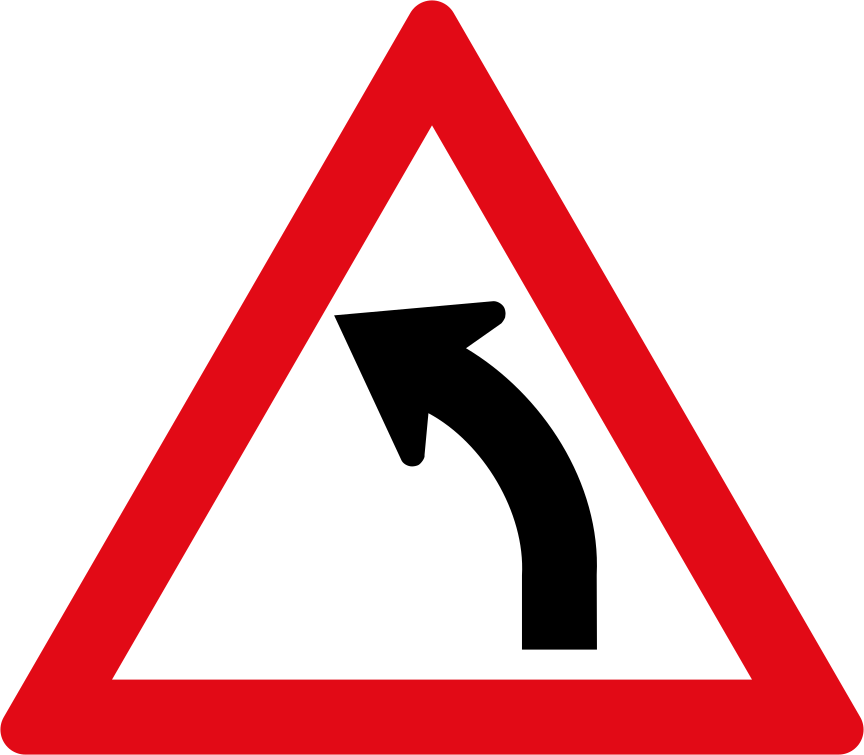
- An unpaved road surface lies ahead.
- The road descends steeply ahead.
- The road changes direction ahead.
Show the answer
Answer C: The road changes direction ahead.
Reduce speed before the bend, following the direction shown.
Memory tip: W203 · Curve ahead
All vehicle codes
More signs and markings chapters
- Pedestrian, cycle, noise and lift bans
- Reserved lanes and freeways
- Junction warning signs
- Narrowing and two-way warnings
- Warnings of controls ahead
- People and animals on the road
Sources: NaTIS Road Traffic Signs, June 2012, PDF p. 26 (names, locations, purposes and actions); iDriving K53 manual, PDF pp. 6–42 (visual comparison; text extraction incomplete); SADC artwork: assets/signs/manifest.json (per-file sources and licences).
AceK53 is an independent study aid based on public road traffic manuals and is not an official test. Always confirm requirements with your driving licence testing centre.