Signs and markings · about 7 min read
Yield and priority signs
Who gives way to whom at junctions, circles, crossings and narrow sections
What you will learn
- Distinguish yielding from stopping.
- Recognise the pedestrian-priority controls and what each allows.
- Decide who goes first at a shared narrow section.
Yield and priority signs: how to read them
Yield signs settle priority without always bringing traffic to a halt. They ask you to arrange your approach so that another road user with priority is never forced to brake or swerve because you arrived.
Three questions help. Who has priority here: vehicles on another road, vehicles already in a circle, pedestrians, or oncoming traffic? What must I do if that road user is close: slow, or stop? And what is the stopping position if I need to stop? The signs below answer different versions of those questions.
When you yield, you are not only checking for danger; you are leaving a visible gap in your own behaviour. A slower approach tells the other driver that you have seen them. Stopping a little early, rather than creeping to the line and braking late, makes your intention obvious to people behind you as well.
Key idea: Priority belongs to someone else. Your job is to leave them undisturbed.
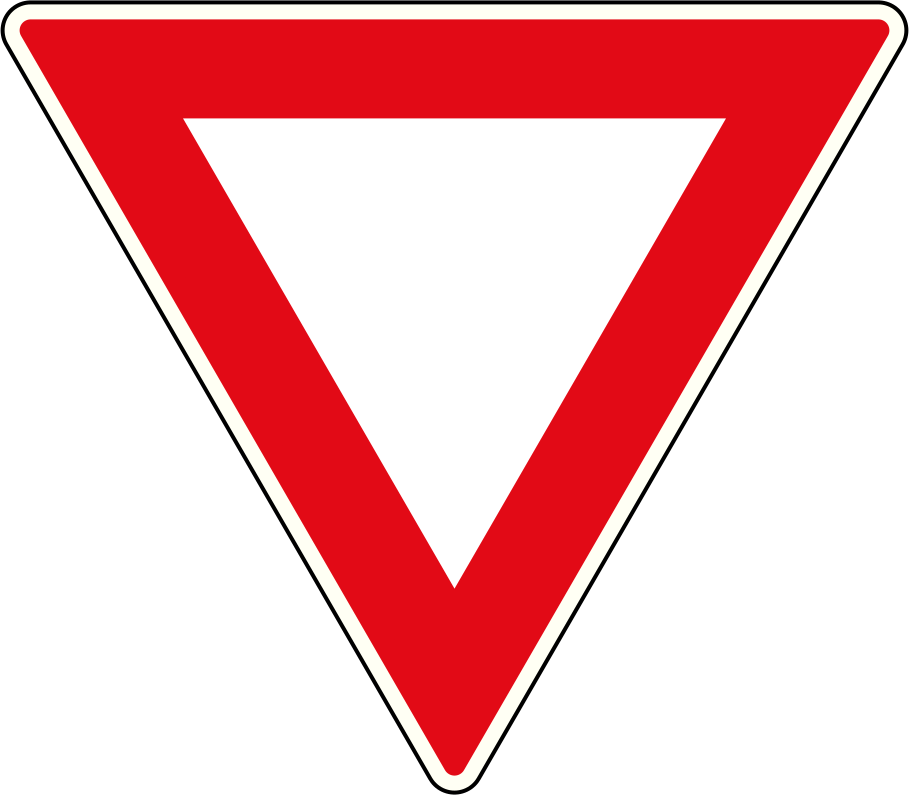
Yield — R2
Give way to traffic on the road you are entering or crossing.
Recognise it. A triangle pointing downwards with a red border and a plain white centre.
Where you meet it. Junctions where your road meets another, railway crossings and some entrances to busy roads.
What to do. Ease off early. Look both ways, and stop if traffic or pedestrians with priority are close enough that your entering would endanger them. If the road is truly clear you may continue without stopping.
In practice. You approach a road you must join. You ease off early, look right and left, see a van close by and wait. When the gap opens, you enter smoothly without making anyone brake.
Easily confused. A yield sign does not always mean stop, but it does always mean give way. Do not confuse it with an upright warning triangle: this one points down.
Key idea: Slow down early. Stop if needed to let traffic or pedestrians pass.
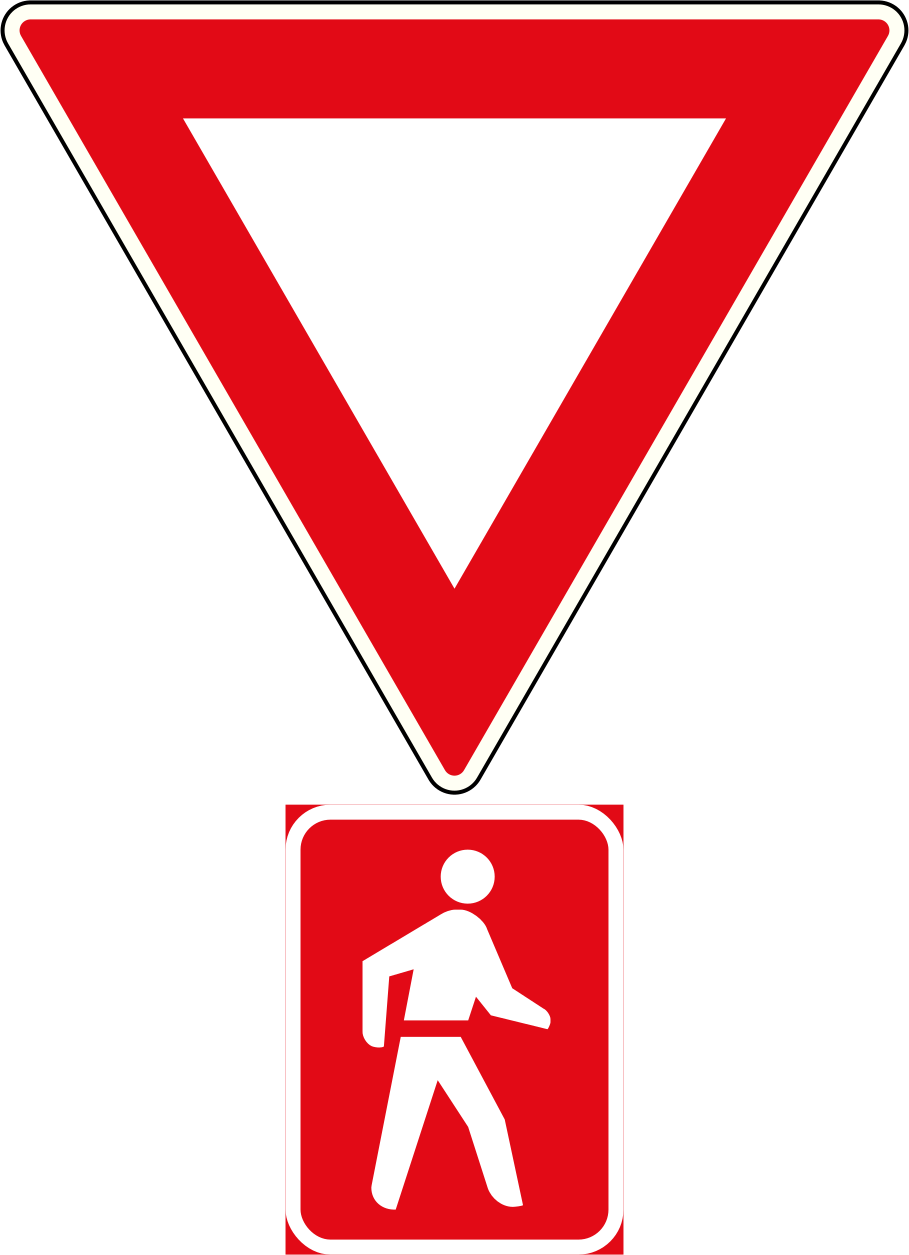
Yield to pedestrians — R2.1
Pedestrians crossing here have priority.
Recognise it. A yield triangle with a small plate beneath it showing a pedestrian figure.
Where you meet it. Intersections and pedestrian crossings where people walking must be given priority over vehicles.
What to do. Slow down, look both ways along the walking route and be ready to stop. Let people finish crossing, and never edge forward to hurry them. Also do not overtake a vehicle that has stopped at the crossing.
In practice. A child steps towards the kerb at a crossing marked with this sign. You slow, stop before the crossing and wait until the child has crossed, then check the other side before you continue.
Easily confused. R2.1 is a catalogue label for this sign, not a vehicle control. The upright pedestrian-crossing warning (W306) only announces the crossing earlier; this sign gives the priority.
Key idea: Slow down and give pedestrians time to cross safely.
Yield at traffic circle — R2.2
Yield at the controlled traffic circle or mini circle.
Recognise it. A yield triangle containing black arrows chasing each other in a circle.
Where you meet it. Traffic circles, particularly mini-circles where there is no large central island.
What to do. Slow down and yield to vehicles already in the circle and to any driver who reaches the yield line before you reach yours. Signal in time for your exit and stop if you must.
In practice. You enter a mini-circle at the same moment as another driver. You check who reached the yield line first, give way if it was them, and signal your exit as you go round.
Easily confused. This is the control at the entrance; it is not the blue clockwise command (R137) or the warning that a circle is ahead. Do not apply a blanket “give way to the right” habit without reading the line.
Key idea: Yield to vehicles already in the circle and those reaching their yield line before you reach yours. Stop when needed.
Pedestrian priority zone — R5
A pedestrian-priority area with entry limited to specified uses.
Recognise it. A red diamond with a white pedestrian figure. Diamonds are unusual among regulatory signs, which helps you spot it.
Where you meet it. The entrance to an area intended for people on foot, such as a pedestrian street.
What to do. Enter only if you are an emergency vehicle, a vehicle loading or off-loading goods, or a maintenance vehicle. Drive carefully at no more than 15 km/h, give priority to pedestrians crossing or wanting to cross, and load or off-load only in areas marked by signs. No other vehicle may enter.
In practice. A delivery driver reaches a pedestrian street with this sign. They enter only to load at the marked bay, keep to a walking pace under 15 km/h and stop whenever someone starts to cross in front of them.
Easily confused. Pedestrians-only (R110) admits no motor vehicles at all, while this sign admits a short list of working vehicles at a crawl. Neither is a shortcut for ordinary traffic.
Key idea: Only permitted emergency, loading and maintenance vehicles may enter; give pedestrians priority and observe the reference 15 km/h limit.
Yield to oncoming traffic — R6
Oncoming traffic has priority through the narrow section.
Recognise it. A red-bordered circle with two vertical arrows: one red and one black. The red arrow marks the direction that must give way; the black arrow the direction with priority.
Where you meet it. The entrance to a narrow single carriageway section used by traffic from both directions.
What to do. Stop or hold back before the narrow part if oncoming traffic is already in it or about to enter it. Go only when you can pass through without meeting another vehicle in the gap.
In practice. A narrow causeway has one lane. A bakkie is already crossing from the other side. You wait before the narrow section until it has cleared, then drive through when no one else is in it.
Easily confused. It is not a one-way sign, and it is not a speed or width limit. The question it answers is simply who goes first through a shared single lane.
Key idea: Wait before the narrow section until oncoming vehicles have passed.
Pedestrian priority at a glance
R2.1 gives pedestrians priority at a crossing or junction, so you slow and stop when they wait or cross. R5 marks an entire area for pedestrians where only emergency, loading and maintenance vehicles may enter, at no more than 15 km/h. R2.2 gives priority to the circle and to whoever reaches the yield line first. R6 settles which direction waits at a narrow shared lane.
Each asks for the same attitude: look for the person or vehicle with priority first, then decide whether you can go without affecting them.
Key idea: Priority belongs to someone else. Your job is to leave them undisturbed.
A mini-circle with two cars arriving together
You and another car both approach a mini-circle with yield markings. A third car is already circulating.
- Slow before the yield line and watch the vehicle already in the circle.
- Give way to it and to any driver who reaches the line before you.
- Signal your exit in good time.
- Enter only when you will not force anyone to brake.
Quick recap
- A yield sign does not always mean stop, but it always means give way.
- R2.1 gives pedestrians priority at a crossing.
- R5 admits only limited vehicles at 15 km/h.
- R6 tells one direction to wait at a narrow section.
Practice questions on yield and priority signs
1 What does this sign mean?
- You may not exceed 120 km/h.
- Give way to traffic on the road you are entering or crossing.
- You must turn right at this point.
Show the answer
Answer B: Give way to traffic on the road you are entering or crossing.
Slow down early. Stop if needed to let traffic or pedestrians pass.
Memory tip: R2 · Yield
All vehicle codes
2 Which response fits this sign?
- Check, signal and turn right safely.
- Adjust your speed to the road and weather conditions.
- Slow down early. Stop if needed to let traffic or pedestrians pass.
Show the answer
Answer C: Slow down early. Stop if needed to let traffic or pedestrians pass.
Yield: Give way to traffic on the road you are entering or crossing.
Memory tip: Slow down early. Stop if needed to let traffic or pedestrians pass.
All vehicle codes
3 Which sign group does this example belong to?
- Warning
- Control
- Command
Show the answer
Answer B: Control
Yield is a control sign. Give way to traffic on the road you are entering or crossing.
Memory tip: Slow down early. Stop if needed to let traffic or pedestrians pass.
All vehicle codes
4 What does this sign mean?
- Pedestrians crossing here have priority.
- Sounding the horn is prohibited for the next 100 metres.
- Continue straight at this point.
Show the answer
Answer A: Pedestrians crossing here have priority.
Slow down and give pedestrians time to cross safely.
Memory tip: R2.1 · Yield to pedestrians
All vehicle codes
Part of the guide: Four-way stops and right of way, Traffic circles
More signs and markings chapters
- Road-edge, crossing-approach and lane-change markings
- Guidance, information and supplementary signs
- Stop controls
- No entry and one-way roads
- Direction commands and roundabouts
- Who may use the road
Sources: NaTIS Road Traffic Signs, June 2012, PDF pp. 5–6 (names, locations, purposes and actions); iDriving K53 manual, PDF pp. 6–42 (visual comparison; text extraction incomplete); SADC artwork: assets/signs/manifest.json (per-file sources and licences).
AceK53 is an independent study aid based on public road traffic manuals and is not an official test. Always confirm requirements with your driving licence testing centre.