Signs and markings · about 6 min read
Stop controls
Every kind of stop sign, and when you may move off
What you will learn
- Recognise each stop control by its shape and plate.
- Stop at the right place and use arrival order at an all-way stop.
- Tell a permanent stop sign from a hand-held STOP/GO board.
Stop controls: how to read them
A stop control tells you that your journey must pause. All of them share one core duty: bring the vehicle to a complete standstill at the stopping position. The differences are in who else must stop, and how you decide when to move.
The plain STOP sign is the model. The variants add a plate or an extra symbol: a number for how many approaches stop, a yield triangle that lets left-turners merge, or a hand-held board that changes face. Read what is added, because it changes what you must do.
Key idea: Stop completely first. Then read the added plate or symbol to learn who goes next.
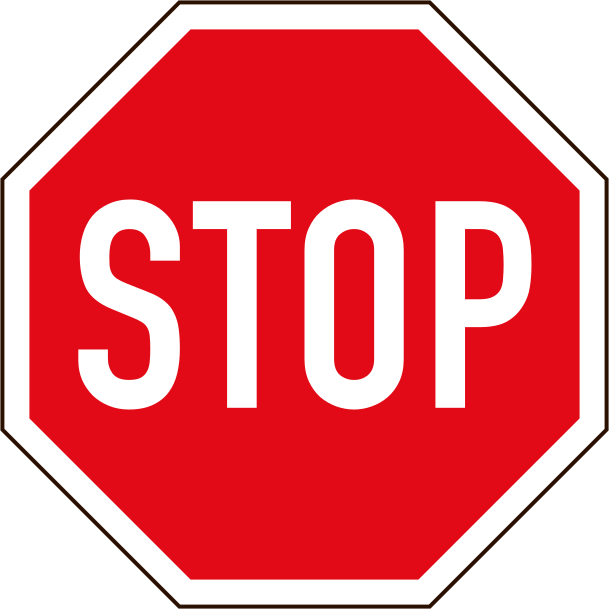
Stop — R1
You must come to a complete stop.
Recognise it. A red octagon with white STOP lettering. No other road sign has eight sides, so it can be recognised even when dirt hides the word or you see its back.
Where you meet it. Junctions, railway crossings and school-patrol crossings. A white stop line is usually painted across your lane in front of it.
What to do. Brake early enough to stop with the whole vehicle behind the stop line. With no line, stop with the front of the vehicle level with the sign. At a multi-way stop, wait for vehicles that stopped before you to move off. Move only once the way is clear.
In practice. You reach a quiet intersection at night with no lights in sight. You still stop behind the line, look each way and wait for pedestrians to clear, because the sign needs a standstill whether or not anyone is there.
Easily confused. The stopping position is the line, not the sign post. A slow roll to “see better” is not a stop, and an empty junction does not cancel the requirement.
Key idea: Stop behind the stop line. Look for traffic and pedestrians, then continue when safe.
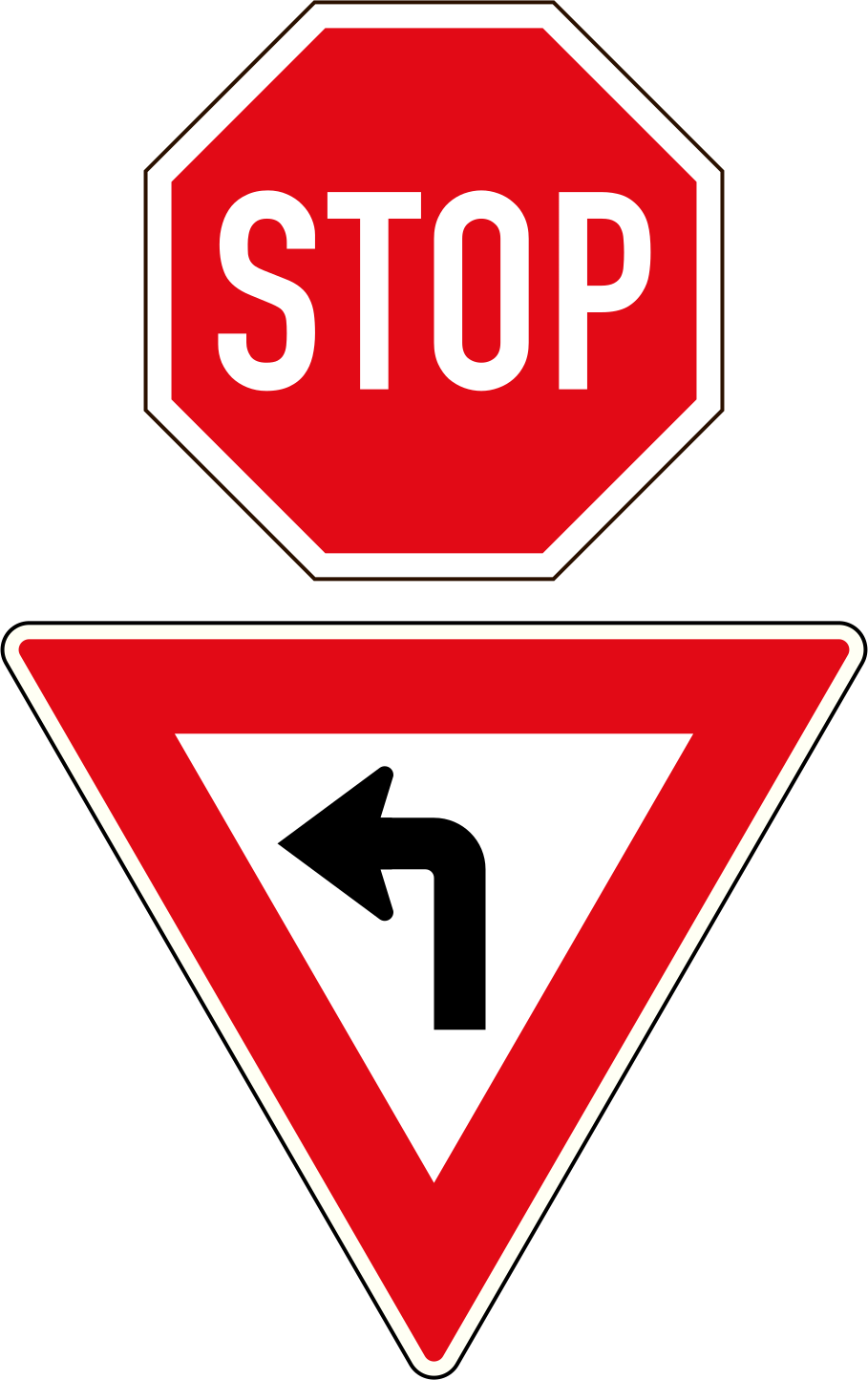
Stop with left-turn yield — R1.2
Stop for straight or right movements; left-turning traffic must yield.
Recognise it. A STOP sign mounted above a small yield triangle that contains a left-turn arrow.
Where you meet it. Junctions where traffic turning left can safely merge without first coming to a standstill, so only the other movements need to stop.
What to do. If you are going straight or turning right, stop behind the line as at any stop sign. If you are turning left, give way to cross-traffic and pedestrians close enough to be a hazard, and go only when it is safe.
In practice. You are in the left lane and want to turn left. You slow, check the cross-traffic and merge when there is a safe gap. A driver beside you wants to go straight, so they must stop at the line.
Easily confused. The left-turn allowance belongs to this combined sign only. At a plain R1 sign every movement, including a left turn, must stop.
Key idea: For a left turn, yield to relevant traffic and pedestrians and proceed only when safe. For other movements, stop behind the line.
Three-way stop — R1.3
The three junction approaches have stop controls.
Recognise it. A STOP sign with a small plate showing the number 3 beneath it.
Where you meet it. A junction where all three approaches carry a stop sign, so everyone arriving must stop.
What to do. Stop completely at your line, then watch who else has stopped. The vehicle that stopped first moves off first. Check pedestrians and the junction before you go.
In practice. Three cars reach a T-junction together. You note the order they stopped, wait your turn and check each pedestrian crossing before moving, instead of trusting a wave from another driver.
Easily confused. The plate tells you how many approaches are controlled; it does not let several vehicles move at once. If the order is unclear, stay put until it is safe.
Key idea: Stop completely and observe which vehicles stopped before you. Proceed in the stopping order only when safe.
Four-way stop — R1.4
Every approach to this junction has a stop control.
Recognise it. A STOP sign with a small plate showing the number 4 beneath it.
Where you meet it. A four-way intersection where every approach has a stop sign.
What to do. Stop behind the line, or level with the sign if there is no line. When more than one vehicle has stopped, the one that stopped first moves off first. Proceed only when the crossing is clear.
In practice. At a four-way stop, a car on your left stops a moment before you. You let it go first, then check that its path is clear and the junction is empty before you move off.
Easily confused. “First to stop, first to go” is about arrival order, not speed. Do not hurry to beat another driver to the line or assume someone will yield to you.
Key idea: Stop completely. Vehicles normally proceed in the order they stopped.
Manual STOP/GO control — R1.5
A manually operated board indicates whether you must stop or may proceed cautiously.
Recognise it. A hand-held board with two faces: a red octagon marked STOP on one side and a yellow GO octagon on the other.
Where you meet it. Roadworks and other places where a trained person controls a single lane or a narrow section for a short time.
What to do. Stop and wait while STOP faces you. When the board turns to GO, move off with caution, but only if the way ahead is clear.
In practice. At roadworks a worker turns the board to STOP as you approach. You stop well back, wait for the face to change to GO, check the lane ahead for plant or workers and then move off slowly.
Easily confused. The operator can reverse the board at any moment, so do not simply follow the vehicle in front. Obey the face turned towards you now.
Key idea: Stop when STOP faces you. Move only when GO is displayed and the route is safe.
Reading the differences
Start with the shape: eight sides means stop. Then look for anything added. A number plate (3 or 4) tells you every approach stops, so arrival order decides who goes. A yield triangle beneath the sign changes the rule only for the movement it shows. A hand-held board is temporary and can change face while you watch.
What never changes is the standstill. Counting arrival order, checking pedestrians and choosing a safe gap all happen after you have stopped, not instead of stopping.
Key idea: Stop completely first. Then read the added plate or symbol to learn who goes next.
A four-way stop with three cars
You stop at a four-way stop just after a van on your right and just before a taxi on your left.
- Stop behind the line even though no one else has moved yet.
- Note that the van stopped before you and the taxi after you.
- Let the van go first, then check the junction and pedestrians before you move.
- Move off only when the path is clear; the taxi follows after you.
Quick recap
- Octagon means a complete stop.
- The stop line, not the sign post, is the stopping position.
- First to stop is first to go, but only when safe.
- A hand-held STOP/GO board can change at any time.
Practice questions on stop controls
1 What does this sign mean?
- You may not exceed 80 km/h.
- Pass to the right of the obstruction or traffic island.
- You must come to a complete stop.
Show the answer
Answer C: You must come to a complete stop.
Stop behind the stop line. Look for traffic and pedestrians, then continue when safe.
Memory tip: R1 · Stop
All vehicle codes
2 Which response fits this sign?
- Stop behind the stop line. Look for traffic and pedestrians, then continue when safe.
- The posted limit is a ceiling, not a target.
- Follow the arrow while observing other traffic.
Show the answer
Answer A: Stop behind the stop line. Look for traffic and pedestrians, then continue when safe.
Stop: You must come to a complete stop.
Memory tip: Stop behind the stop line. Look for traffic and pedestrians, then continue when safe.
All vehicle codes
3 Which sign group does this example belong to?
- Command
- Control
- Warning
Show the answer
Answer B: Control
Stop is a control sign. You must come to a complete stop.
Memory tip: Stop behind the stop line. Look for traffic and pedestrians, then continue when safe.
All vehicle codes
4 What does this sign mean?
- This route is for pedal cycles.
- Give way to traffic on the road you are entering or crossing.
- Stop for straight or right movements; left-turning traffic must yield.
Show the answer
Answer C: Stop for straight or right movements; left-turning traffic must yield.
For a left turn, yield to relevant traffic and pedestrians and proceed only when safe. For other movements, stop behind the line.
Memory tip: R1.2 · Stop with left-turn yield
All vehicle codes
Part of the guide: Four-way stops and right of way
More signs and markings chapters
- Stop lines, lane arrows and reserved road space
- Road-edge, crossing-approach and lane-change markings
- Guidance, information and supplementary signs
- Yield and priority signs
- No entry and one-way roads
- Direction commands and roundabouts
Sources: NaTIS Road Traffic Signs, June 2012, PDF pp. 5–6 (names, locations, purposes and actions); iDriving K53 manual, PDF pp. 6–42 (visual comparison; text extraction incomplete); SADC artwork: assets/signs/manifest.json (per-file sources and licences).
AceK53 is an independent study aid based on public road traffic manuals and is not an official test. Always confirm requirements with your driving licence testing centre.