Signs and markings · about 5 min read
Stop and yield signs
Recognise the control, find the stopping point and give way
What you will learn
- Distinguish a complete stop from yielding.
- Recognise pedestrian and oncoming-traffic priority.
- Use a stop line without blocking the crossing.
What a control sign does
A control sign tells you how to enter, cross or use a particular part of the road. It may require a stop, require you to give way, or prevent entry from your direction. You normally encounter these signs at junctions, crossings, entrances and narrow sections where road users could meet.
“Yield” means give way: arrange your approach so another road user with priority does not have to brake or swerve because you entered. “Stop” means the vehicle must become completely stationary. These are different instructions, even when the road looks empty.
Codes such as R1 and R2 identify signs in reference manuals. They are catalogue labels, not controls inside the vehicle. Learn the sign’s everyday name, picture and required action first.
Key idea: Identify the instruction before deciding whether you may move.
The stop sign and stop line
Recognise the stop sign by its red eight-sided shape and white STOP lettering. It is used at intersections, railway crossings and other controlled stopping points. Its unusual shape helps distinguish it from other signs.
Slow down early and bring the entire vehicle to a complete standstill behind the stop line. The front of the vehicle must not project into the pedestrian crossing or junction. If there is no stop line, the reference manual places the front of the vehicle in line with the stop sign.
After stopping, check the road and pedestrian paths in every relevant direction. If your view is obstructed, make the required stop first, then move cautiously only as far as is safe to improve your view. A rolling stop is not a complete stop. Do not follow the car ahead through without making your own stop.
Key idea: Stop completely at the correct place, then assess whether you can proceed.
Three-way and four-way stops
At an all-way stop, each controlled approach must stop. The four-way-stop sign adds an indication that four approaches are controlled. Vehicles normally move in the order in which they stopped, not in the order in which their drivers sounded the horn or began accelerating.
Watch the other approaches as you arrive so you can establish who stopped before you. Wait for those vehicles to move, and check that their paths are clear before moving yourself. Each vehicle must still make its own stop.
If arrival order is uncertain, do not force your way through. Remain stopped, observe and proceed only once there is a safe, unambiguous opportunity. The example below shows a known arrival order; it does not settle every possible simultaneous-arrival situation.
Key idea: Arrival order helps organise traffic; observation prevents conflict.
The yield sign
The yield sign is an inverted triangle with a red border and light centre. Unlike the ordinary warning triangle, its point faces down. It is often placed where your road joins another road or at a controlled entrance.
Reduce speed while you still have room to stop. Look for traffic on the road you are entering or crossing, and for pedestrians in your intended path. If another road user is close enough that your movement would create a hazard, wait and stop when necessary.
You need not stop simply because a yield sign exists if the road is genuinely clear and you can enter safely. However, poor visibility, a queue or approaching traffic may make stopping necessary. A glance at an empty part of the road is not a complete check.
Key idea: Yield means give way; stop whenever that is necessary.
Yield to pedestrians — R2.1
R2.1 is the reference code for the “Yield to pedestrians” sign shown here. It is a control sign used at pedestrian crossings and intersections. Its purpose is to give priority to pedestrians crossing or wanting to cross the road.
Recognise the pedestrian symbol and relate it to the crossing or walking route ahead. Check both sides of the road, including people whose view may be hidden by parked or stopped vehicles. Reduce speed enough to stop before the pedestrian’s path.
Give pedestrians time and space to cross. Do not edge forward into their route or use the horn to hurry them. If a vehicle has stopped at a pedestrian crossing, do not pass it: it may be hiding a person crossing in front of it.
A triangular “pedestrian crossing ahead” warning tells you a crossing is coming; this control sign specifies priority at the crossing. The two signs have different jobs.
Key idea: R2.1 means yield to pedestrians, including those wanting to cross.
No entry, one-way roads and narrow sections
The no-entry sign is a red disc with a white horizontal bar. It commonly faces you at the wrong end of a one-way street or freeway off-ramp. Do not enter past it, even if you see no traffic.
A one-way roadway sign uses an arrow to show the permitted travel direction. If you choose that roadway, follow the arrow. It does not give you permission to enter without checking the junction.
“Yield to oncoming traffic” is a different control, used where vehicles from both directions share a narrow section. Wait before the narrow part for traffic with priority and vehicles already occupying it. Do not enter and expect the other driver to squeeze around you.
Key idea: Read the type of control: entry, direction and priority are separate instructions.
A pedestrian beside a quiet crossing
You approach R2.1. A person is waiting beside the marked crossing; there are no other cars.
- Identify the pedestrian-priority sign and reduce speed before reaching the crossing.
- Check both sides and stop before the crossing to give the pedestrian priority.
- Remain clear of the crossing while the person crosses.
- Check again for other pedestrians and traffic, then move when the route is safe.
Quick recap
- A stop always requires a complete standstill.
- Yield may require a stop; the priority road user must not be endangered.
- R2.1 gives pedestrian priority.
- Do not enter past a no-entry sign.
Practice questions on stop and yield signs
1 What does this sign mean?
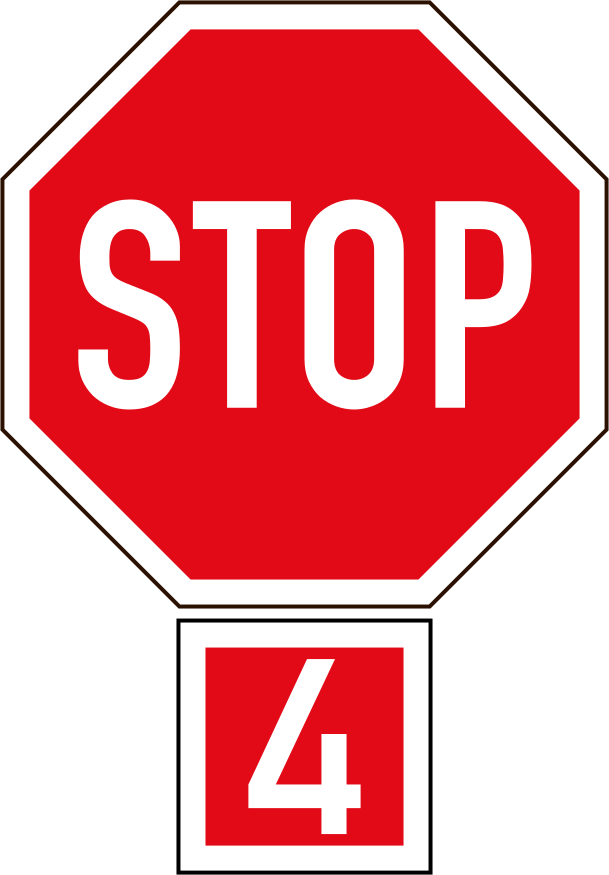
- Every approach to this junction has a stop control.
- You may not exceed 100 km/h.
- You must turn left at this point.
Show the answer
Answer A: Every approach to this junction has a stop control.
Stop completely. Vehicles normally proceed in the order they stopped.
Memory tip: R1.4 · Four-way stop
All vehicle codes
2 What does this sign mean?
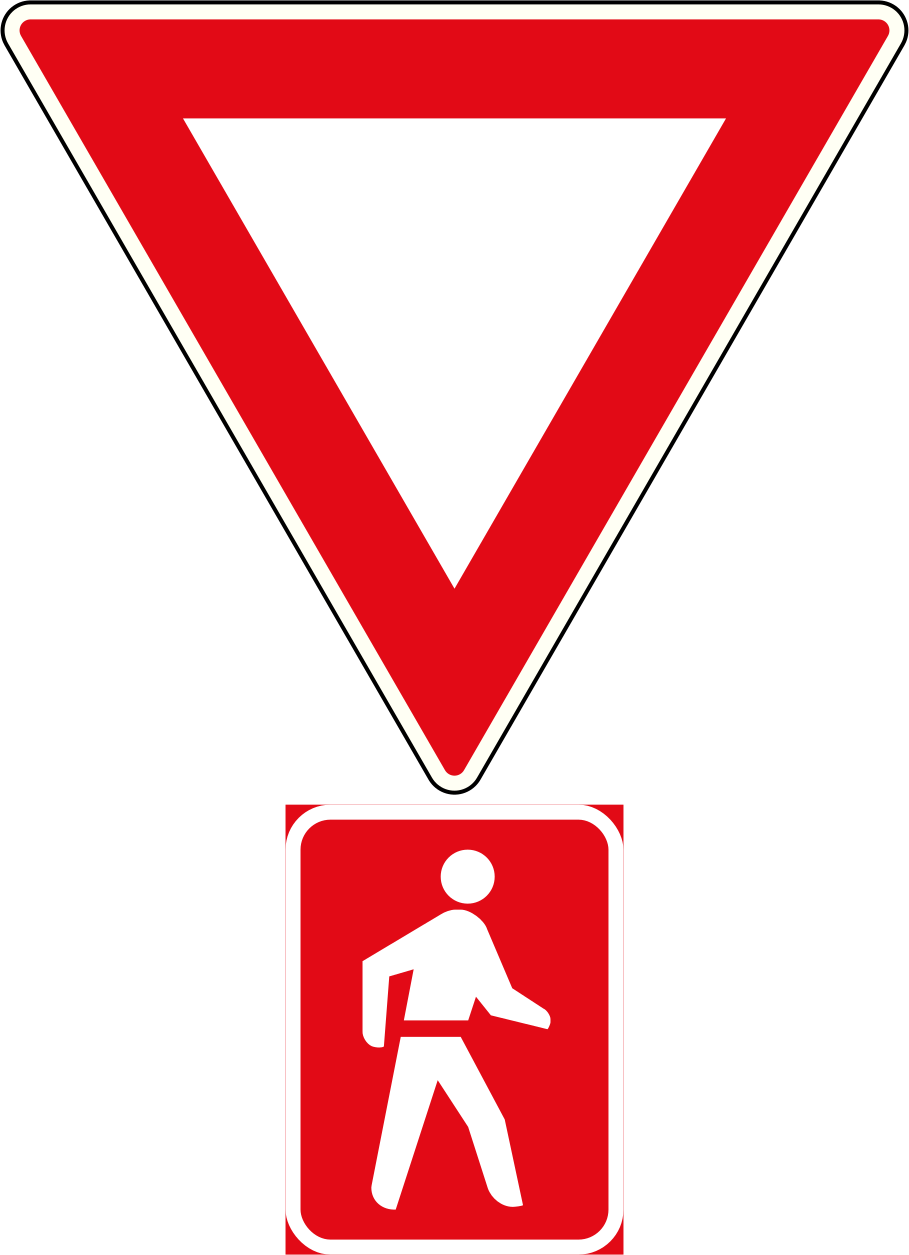
- Pedestrians crossing here have priority.
- Sounding the horn is prohibited for the next 100 metres.
- Continue straight at this point.
Show the answer
Answer A: Pedestrians crossing here have priority.
Slow down and give pedestrians time to cross safely.
Memory tip: R2.1 · Yield to pedestrians
All vehicle codes
3 What does this sign mean?
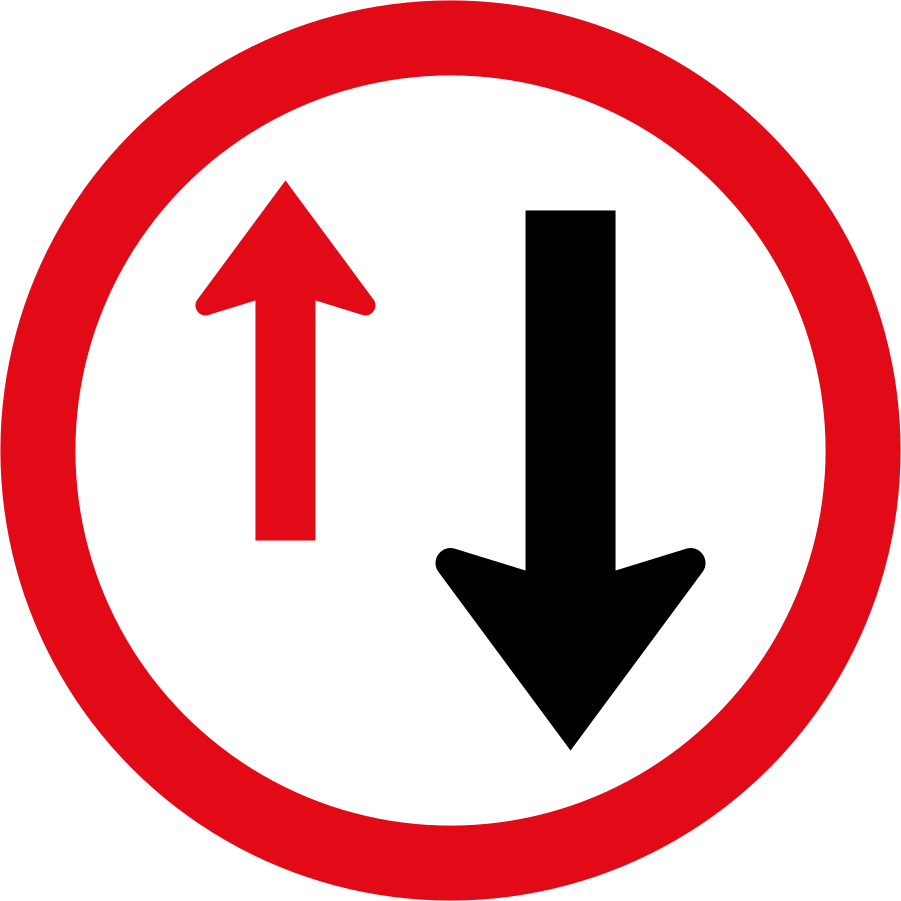
- Oncoming traffic has priority through the narrow section.
- Heavy vehicles may not overtake other heavy vehicles for the next 500 metres.
- This route is for pedestrians.
Show the answer
Answer A: Oncoming traffic has priority through the narrow section.
Wait before the narrow section until oncoming vehicles have passed.
Memory tip: R6 · Yield to oncoming traffic
All vehicle codes
More signs and markings chapters
- Speed signs and mandatory directions
- Warning signs and temporary road controls
- Prohibition signs and restricted movements
- Signals, reservations and freeways
- Traffic lights and signal-controlled crossings
- Failed and flashing traffic signals
Sources: NaTIS Road Traffic Signs, PDF pp. 3–6 (control signs); iDriving K53 manual, PDF pp. 6–8 (reference comparison).
AceK53 is an independent study aid based on public road traffic manuals and is not an official test. Always confirm requirements with your driving licence testing centre.