Signs and markings · about 3 min read
Prohibition signs and restricted movements
Identify what is prohibited and where it applies
What you will learn
- Distinguish no parking from no stopping.
- Recognise prohibited turns and vehicle classes.
- Read supplementary conditions with the main sign.
Reading a prohibition sign
Prohibition signs prevent an action or a class of road user from using a place. Many use a red-bordered circle with the prohibited symbol inside; parking and stopping signs use their distinctive blue centre and red bars. Read the full symbol rather than interpreting a red circle only as “danger”.
They may apply at a movement, along a road section or to a specified class. Supplementary plates can add time periods, vehicle types, distances or directions. A rule applying only to a specified class must be read with that condition; it is not permission to ignore other rules.
Plan a permitted alternative before reaching the restriction. A quiet road or empty parking bay does not cancel the sign.
Key idea: Read the action, place and conditions together.
No parking and no stopping
No parking uses a red diagonal bar across a blue circle. No stopping uses a red cross across the blue circle. Parking means remaining stationary longer than reasonably necessary for actual loading or unloading under the legal definition; sitting in the car does not automatically avoid that definition.
A no-stopping restriction also prohibits a brief voluntary passenger pickup or drop-off. Stops needed to obey a traffic officer or signal, avoid a collision or deal with circumstances beyond your control are different from convenience stops.
A no-parking sign is not blanket permission to load anywhere: the separate stopping rules, visibility, access and obstruction risks still apply. Check the signed extent and any time plates, and find a lawful place.
Key idea: No stopping is more restrictive than no parking for voluntary stops.
U-turns and prohibited left or right turns
A U-turn reverses your direction of travel so you face the opposite way. The crossed U-shaped arrow prohibits that manoeuvre. Continue to a safe, permitted route rather than attempting a quick turn because traffic seems clear.
A crossed left or right arrow prohibits that direction at the signed point or junction ahead, depending on the illustrated arrow. Check whether the turn is prohibited now or at the next junction. Choose a different permitted movement, observing lane markings and signals.
A turn being allowed does not mean it is safe at that moment. Give way to relevant traffic and pedestrians and avoid abrupt changes from a wrong lane.
Key idea: A prohibition removes a movement; all conditions still govern the alternative.
Overtaking and excluded road users
The no-overtaking sign prohibits the indicated passing movement for the applicable road section. The selected reference gives a 500-metre effect for the ordinary sign unless the signed conditions specify otherwise. The heavy-vehicle version is a separate restriction on heavy vehicles overtaking other heavy vehicles.
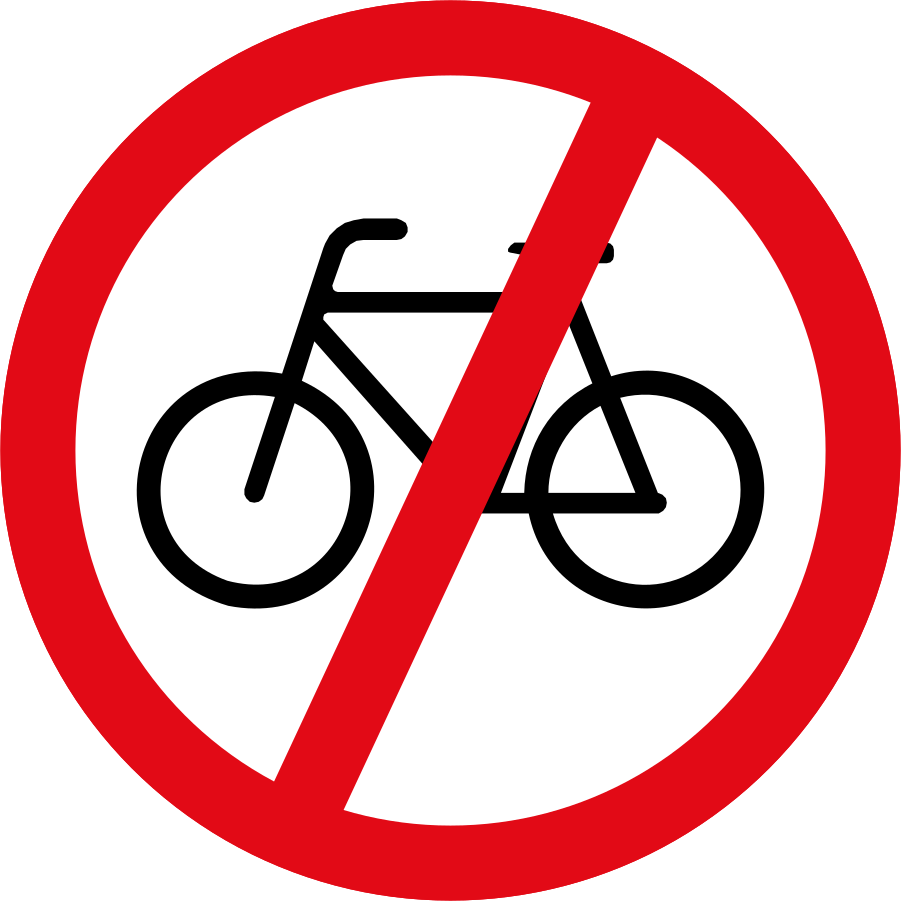
Pedestrians-prohibited and cyclists-prohibited signs exclude the pictured users from the controlled route. Those road users need an alternative permitted path. A motor driver must nevertheless look out for anyone who enters despite the restriction and act to prevent a collision.
Vehicle mass, height, length and width signs require comparison with the actual vehicle and load. A guess based on the cab alone is not an adequate clearance check.
Key idea: Identify the restricted movement or user; keep observing despite the prohibition.
Passenger pickup beside no stopping
A passenger asks you to pause briefly where a no-stopping sign is displayed.
- Recognise that a brief voluntary pickup is still stopping.
- Do not stop there or use hazard lights as an exception.
- Find a safe permitted place and check the passenger’s route before stopping.
Quick recap
- No parking and no stopping differ.
- A sign’s condition is part of its instruction.
- Do not make a prohibited turn.
- Continue observing road users who may ignore a restriction.
Practice questions on prohibition signs and restricted movements
1 What does this sign mean?
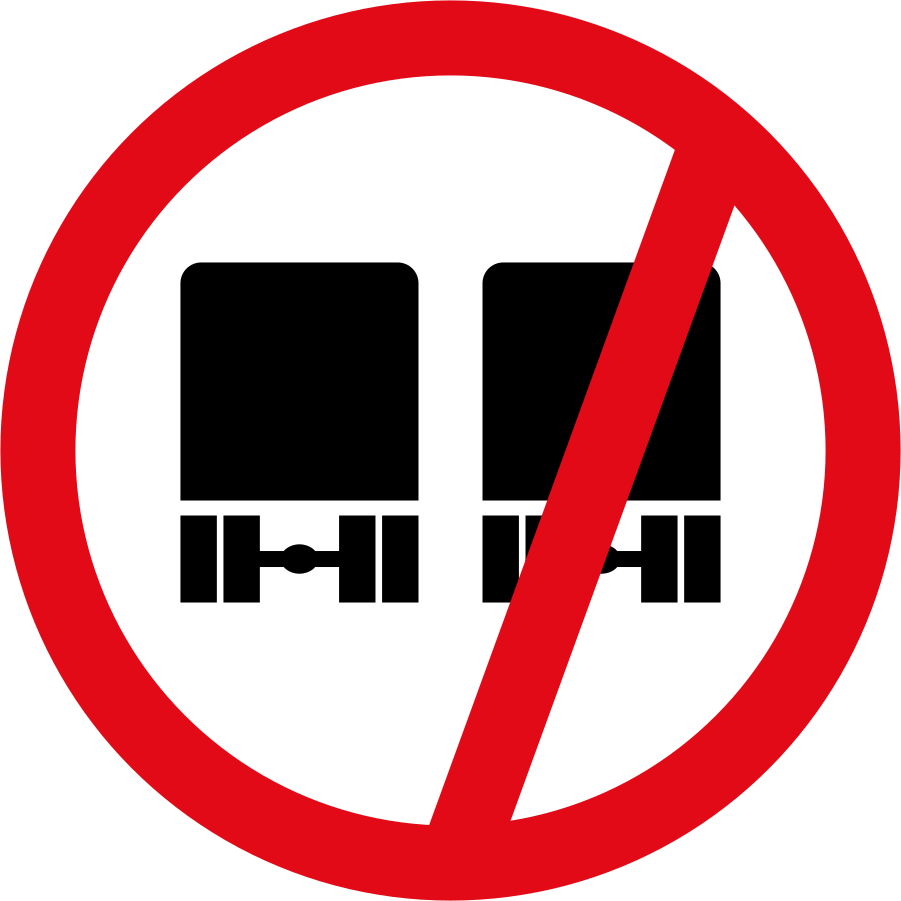
- Heavy vehicles may not overtake other heavy vehicles for the next 500 metres.
- Horses may be on or near the road ahead.
- The road changes direction ahead.
Show the answer
Answer A: Heavy vehicles may not overtake other heavy vehicles for the next 500 metres.
If the restriction applies to your vehicle, remain behind the heavy vehicle ahead.
Memory tip: R215 · No heavy-vehicle overtaking
All vehicle codes
2 What does this sign mean?
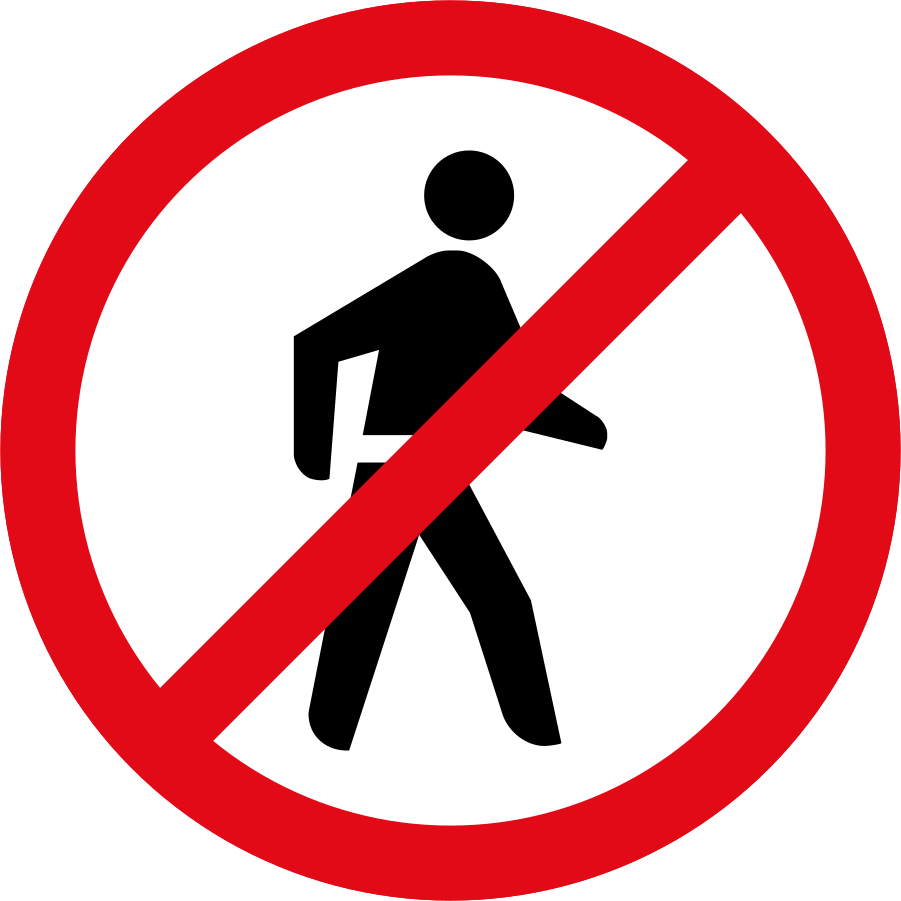
- Pedestrians may not use this road.
- A gate lies across the road ahead.
- A stop sign is ahead.
Show the answer
Answer A: Pedestrians may not use this road.
Use a permitted pedestrian route.
Memory tip: R218 · No pedestrians
All vehicle codes
3 What does this sign mean?
- A tunnel lies ahead.
- A yield sign is ahead.
- Pedal cycles are prohibited on this road.
Show the answer
Answer C: Pedal cycles are prohibited on this road.
Use another route when cycling.
Memory tip: R219 · No cyclists
All vehicle codes
More signs and markings chapters
- Stop and yield signs
- Speed signs and mandatory directions
- Warning signs and temporary road controls
- Signals, reservations and freeways
- Traffic lights and signal-controlled crossings
- Failed and flashing traffic signals
Sources: NaTIS Road Traffic Signs, PDF pp. 12–16, 21–23; NaTIS Rules of the Road, PDF pp. 35–36.
AceK53 is an independent study aid based on public road traffic manuals and is not an official test. Always confirm requirements with your driving licence testing centre.